|
|
|
 |
|
|
|||||||||
Security faults blamed for boost in theft of personal data
Mobile phones will be hackers' main target in the future, according to a network security report.
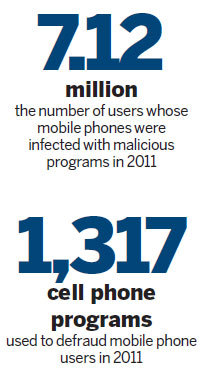
About 7.12 million Internet-capable smartphones were infected with malicious programs in 2011 and the number has been increasing rapidly, according to the report by China's National Computer Network Emergency Response Technical Team.
The team found and terminated 6,249 malicious programs last year, more than twice as many as in 2010, the report said.
Hackers often designed software and applications to destroy mobile phone systems to get users' personal information, taking remote control of them and stealing bank account information or passwords, the report said.
More than 1,317 of the malicious programs were used to charge cell phone users fraudulent fees, the report said, adding that it is hackers' source of money.
According to the report, Nokia's Symbian and Google's Android mobile phone systems were targeted by hackers last year and the number of malicious applications aimed at the latter continues to grow.
Aside from mobile phones, social websites and online forums, which collect significant user information, have also become easy prey for hackers, the report said.
Hackers take advantage of poor network security to steal users' information and then sell their "booty" to transaction websites, which causes serious losses to netizens, the report said.
"Nowadays, almost everyone has a cell phone mainly used for surfing the Internet, which offers hackers tremendous financial opportunities," said Wang Minghua, deputy director of the operation department in the team.
"Meanwhile, a few mobile applications and systems have technical loopholes and lack protective programs, allowing people with bad intentions to access and collect private information," he said.
Li Chenguang, an employee of the Beijing branch of China Telecom, said on Thursday that staff negligence causes personal information leaks.
"People who want to buy a new telephone or mobile phone have to tell us their name, identification card number and home address," Li said, and digital records are kept of the information.
Company employees are asked to safeguard buyers' information, but some might succumb to the temptation of huge gains and sell the information, he said.
It's hard to guard against such information leaks, Li said, "because people can easily access a user's information system if they get an employee's ID number."
Zhu Yuchen, a 24-year-old resident of Shanghai, once received phone messages from scammers trying to defraud her after she uploaded personal information to register at social websites.
"I'm angry, and I'm afraid to give out any information online after that," she said.
"I deleted my private introduction on social websites, and I'm more cautious about downloading mobile phone applications."
Zhu has canceled a number of online accounts, even some that used only her e-mail address. "That way, my privacy may be better protected," she said.
However, Zhang Fa, a 26-year-old Beijing resident, said information leaks are unavoidable.
"All I can do is be more careful when I download cell phone software," she said.

|

|

|

|

|

|