|
|
|
 |
|
|
|||||||||
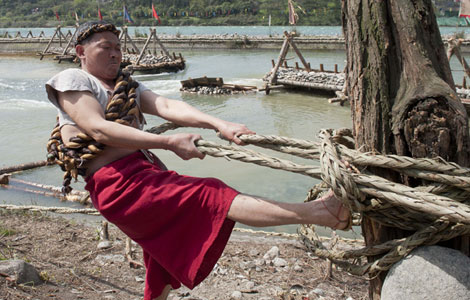
Tens of thousands of people participated in the water-releasing festival on Wednesday to commemorate Li Bing, the governor of Sichuan who built the irrigation project.
During Qingming Festival, or Pure Brightness Festival, Chinese families traditionally visit the tombs of their ancestors to show respect and offer sacrifices.
The phrase "land of abundance" reminds every Chinese person of Sichuan, but how that came to be remains a mystery for many.
It was through the irrigation project that Sichuan got the name.
In ancient times, Chengdu Plain, now one of China's most populous and important agricultural regions, suffered from the incessant flooding of Minjiang River, a tributary of the Yangtze River, in the summer, and withered with drought in the winter.
Li decided to harness the Minjiang and started the construction of Dujiangyan Irrigation Project around 256 BC.
He divided the river in two by building a midstream weir. From there, at Fish Mouth, the Minjiang splits into the Outer River, and the Inner River, which Li Bing diverted to a new course to the east.
The Inner River was divided at Lidui Hill, a manmade embankment, where the west stream was linked to the Outer River through the Flying Sands Spillway, and the east stream squeezes through the Precious Bottleneck Channel to feed a grid of irrigation canals now watering 670,000 hectares in 34 counties of the West Sichuan Plain, compared with 160,000 hectares of arable land when the project was built.
The plain has been more or less spared from flooding and drought for more than 2,000 years, thanks to the project, winning the name the "land of abundance" in ancient times.
"Dig the beds deep; keep the dikes low," Li Bing warned. This principle has been observed ever since, and the spillway and channels are kept in good order to this day.
Since ancient times, workers have used rafts to block the course of the Minjiang each winter to maintain the riverbeds and reinforce the dikes in the dry season. In the spring, they would tear the rafts away to release water and irrigate the plain's farmland.
With the construction of an electrical gateway in 1957, Dujiangyan no longer used rafts to block the water during its annual maintenance and the ceremony was no longer held.
In 1991, the Qingming Water-Releasing Festival resumed. The 40-minute ceremony is now a show representing history.
Of some 700 actors and actresses involved in the ceremony, more than 100 are farmers from neighboring Minjiang village, each earning 20 yuan ($3.20) for a role in one performance, according to Zhang Guirong, a 66-year-old resident of the village whose role is to carry an ox in the ceremony.
According to Dong Guowei, chief of the Dujiangyan city foreign affairs office, the city started preparing for the inclusion of the water-releasing festival on the list of the UNESCO World Intangible Cultural Heritage last year.
|
|

|

|

|

|