|
|
|
 |
|
|
|||||||||
A great number of billionaires have emerged from China, but fostering the country's middle class should be a top priority in order to increase consumer spending, said Xiang Bing, founder and dean of the Cheung Kong Graduate School of Business.
 |
|
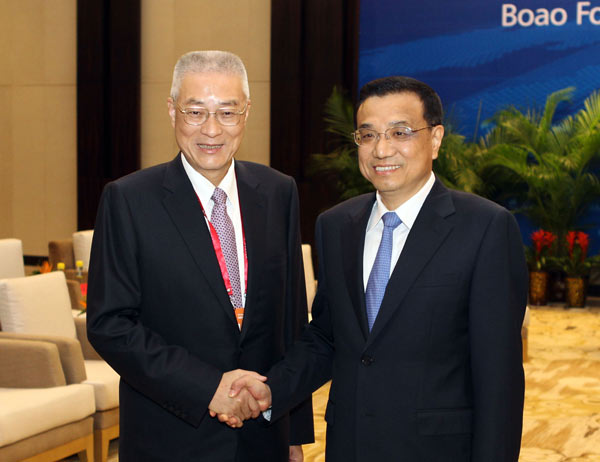
Vice-Premier Li Keqiang (right) shakes hands with Wu Den-yih, chief adviser of the Taiwan-based Cross-Straits Common Market Foundation, at the Boao Forum for Asia in Boao, Hainan province, on Sunday. [Photo by Wu Zhiyi / China Daily] |
The number of Chinese billionaires may overtake the United States in the next five to 10 years, but the rise of middle class has been sluggish, Xiang said in an exclusive interview with China Daily before the start of the 2012 Boao Forum for Asia. He called on entrepreneurs to contribute to building the middle class.
"Companies will play a crucial role, though not an exclusive role, in developing a middle-class society," he said.
Most Chinese entrepreneurs remain ignorant of the benefits of the establishment of a solid middle class and, therefore, do not take measures to bring their employees into the fold of the business, he said.
He cited Ren Zhengfei, founder of a leading Chinese telecom equipment provider Huawei Technologies, as a model to follow. Ren owns only 1.42 percent of the equity shares of the company, while the rest is held by employees.
Wealth inequality
Also, to tackle the challenge, the government should make adjustments to resource allocation. Currently, national wealth is unequally distributed among the population, Xiang said.
According to economists, the country's Gini coefficient is estimated to be as high as 0.52 in 2011, from 0.37 in 2007. The top 1 percent of affluent Chinese families hold 41.4 percent of the nation's wealth, he said, citing a World Bank 2010 report.
The issue of wealth inequality should be seriously dealt with and reforms should be made to promote long-term economic stability, he said.
The success of China's entrepreneurs has been largely attributed to low production costs, he said.
With the enforcement of stricter environmental rules and labor laws, the cost of Chinese products will increase accordingly, forcing businesses to increasingly rely on domestic middle-class consumers.
During the past 20 years, Xiang said he heard many multinational companies complain about China's business environment, despite that they have made significant profits in China.
Compared with local private enterprises, international companies have received preferential treatment in China, he said.
"Either you go and just complain, or you can sit down and do your homework. Those that figure out the different ways of doing business will survive and win in China," he said.
Market accessibility is critical to the future success of China's economy, Xiang added.
"China is as open today as during the Tang Dynasty (AD 618-907). The continuation of that is very important to a successful future for China," he said.
lanlan@chinadaily.com.cn
|
|

|

|

|

|