|
|
|
 |
|
|
|||||||||
BEIJING - Imported biscuits with traces of opium were destroyed by customs in Ningbo, a city in East China's Zhejiang province, officials of the city's Entry-Exit Inspection and Quarantine Bureau said.
 |
|
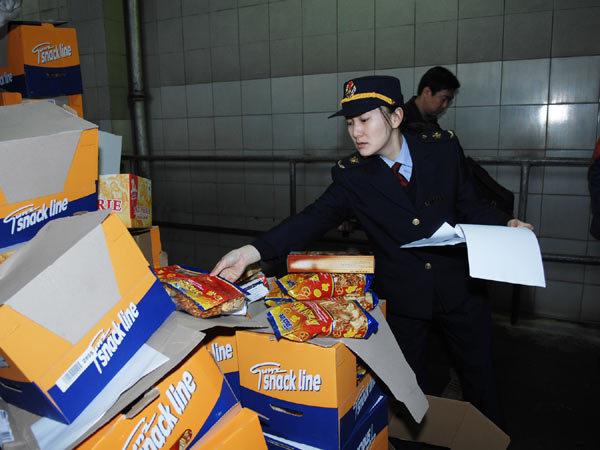
A quarantine and inspection staff worker checks the information of biscuit products found to contain opium ingredients in Ningbo, East China's Zhejiang province, on Tuesday afternoon. A total of 191.5 kg of the biscuits, imported from Germany this February, were destroyed. [Zhou Yanhua / for China Daily] |
This was the first incident of its type in Ningbo in decades. The biscuits, weighing 191.5 kilograms, were tested and destroyed on Tuesday once they were found to have contraband ingredients.
They had been made in Austria and were found to contain ingredients from the poppy plant that are banned in China, according to officials at the inspection and quarantine bureau.
"It's pretty rare that biscuits are found containing such ingredients," Jiang Wenli, an inspector of the bureau, told China Daily on Thursday. The importer of the biscuits may have taken it for granted that these products met Chinese standards, Jiang said.
A trading company based in Zhejiang ordered the biscuits from Germany in February. The company imported 17 categories of biscuits made in different countries, including France, Spain, Italy, Austria, Poland, Belgium, Greece and Germany.
Aside from the biscuits containing opium, one brand was found to have misleading labeling as what was depicted as part of the ingredients could not be matched with what was printed on the package.
Other biscuits tested were found to contain disodium diphosphate, a chemical additive and preservative banned in China.
Food imports have risen by about 15 percent annually in recent years, officials said. Latest statistics show China imported 50 billion yuan ($7.9 billion) of food products in 2010, and it's estimated that the country will become the world’s largest food importer by 2018, with a market worth up to 480 billion yuan.
Ningbo, a major port city in East China, has imported $289 million worth of food and farm produce so far this year, official statistics show.
About 1.04 metric tons of these products, including fruit and wine, worth $10,700, have been destroyed and another 63.5 kilograms were shipped back to their port of origin as they failed to meet food safety standards or breached regulations.
The reporter can be reached at wangzhenghua@chinadaily.om.cn
Wu Ying, iPad, Jeremy Lin, Valentine's Day, Real Name, Whitney Houston, Syria,Iranian issue, Sanyan tourism, Giving birth in Hong Kong, Cadmium spill, housing policy

|
|

|

|

|

|