|
|
|
 |
|
|
|||||||||
Fujian county hailed as a prime mover in fighting land erosion
When driving around Changting county in western Fujian province, you will be surprised to find the villages here are not covered in the red-painted slogans about family planning common in other rural parts of the country.
Instead, the rhyming slogans on the yellow mud brick walls and roadside signboards read "Love and protect forests, our beautiful homeland" or "Returning a piece of green to the forest, putting an inch of ground first for soil conservation".
|
 |
The aim of these simple messages is to increase villagers' environmental awareness, and they are mostly painted in green, the color that best suits the county's new image.
Changting won the green brand after being recognized by the central government for its remarkable success in tackling soil erosion. Over the past 20 years, the county has turned more than 60 percent of its eroded lands into eco-friendly rural areas.
In January, Vice-President Xi Jinping twice singled out Changting's experience in soil erosion control when replying to questions on the environment, and this rare double recommendation put the little-known and once poverty-stricken mountain town firmly in the spotlight.
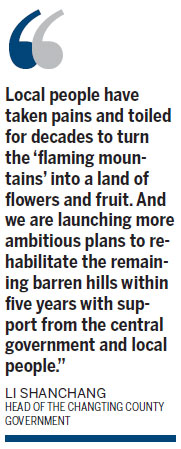
"Local people have taken pains and toiled for decades to turn the 'flaming mountains' into a land of flowers and fruit," said Li Shanchang, head of the Changting county government.
"And we are launching more ambitious plans to rehabilitate the remaining barren hills within five years with support from the central government and local people."
Located on the southern side of Wuyi Mountain among red-soil foothills, Changting was the Party's economic base during the conflicts of the 1930s.
It has a subtropical climate where warm sea air meets the cool air of the mountains, generating lots of rainfall.
"The nature of the land makes it especially vulnerable to rain erosion, which is common to land degradation in the south part of China," said Yue Hui, deputy director of the county's water and soil conservation bureau.
According to Yue, the average annual rainfall in the region reaches 1,700 millimeters, and it is very heavy in the spring monsoon season. Once the vegetation is damaged, the soil on the hillsides is easily washed away and the floodwater ruins crops lower down.
In 1985, a forest survey by satellite found that 97,300 hectares were suffering from soil erosion, 31.5 percent of the county's total land area.
The loss of land was made worse by the human factor as the region is one of the most densely populated areas in China.
In the past, farmers lived in concentrations in forested areas, Yue said, and villagers chopped down wood for fuel. This deforestation led to increased erosion as the soil was washed away.
"At that time, regional poverty and ecological degradation formed a vicious circle," Yue said.
But thankfully in 1983 the provincial government realized the plight, and Xiang Nan, then Party chief of Fujian province, initiated water and soil conservation projects in Changting as a pilot for the province.
Vice-President Xi Jinping also visited the county in 1999 and 2001 when he was Fujian governor.
Since 2000, the provincial government has prioritized soil erosion control in Changting and promised to allocate 10 million yuan ($1.59 million) each year for the program.
"The money, along with local funding, has been used for tree planting, building water conservancy facilities and giving subsidies to farmers to use coal as fuel," Yue said. "It has been very supportive in carrying out complete reforestation projects."
Since 2000, the county has put about 78,500 hectares of eroded land under control, and increased forest coverage to 79.4 percent from 59.8 percent in 1986.
However, there are still 32,000 hectares in Changting that are badly affected by soil erosion.
These lands are in remote mountain areas, some inaccessible by road, and were "a hard nut to crack", Li Shanchang said.
The government will continue to play a leading role in improving the environment, yet local communities needed to be mobilized to get involved in the green projects, Li said.
"Step by step we can make our homeland green and fertile again," he said.
Contact the writers at humeidong@chinadaily.com.cn and tanzongyang@chinadaily.com.cn
Wu Ying, iPad, Jeremy Lin, Valentine's Day, Real Name, Whitney Houston, Syria,Iranian issue, Sanyan tourism, Giving birth in Hong Kong, Cadmium spill, housing policy

|

|

|

|

|

|