|
|||||||||


Institute sets up shelter for babies left in its care
SHIJIAZHUANG - A child welfare institute in the capital of North China's Hebei province has provided the mainland's first safe haven for abandoned newborns, an act that sparked heated debate among child welfare promoters and legal experts.
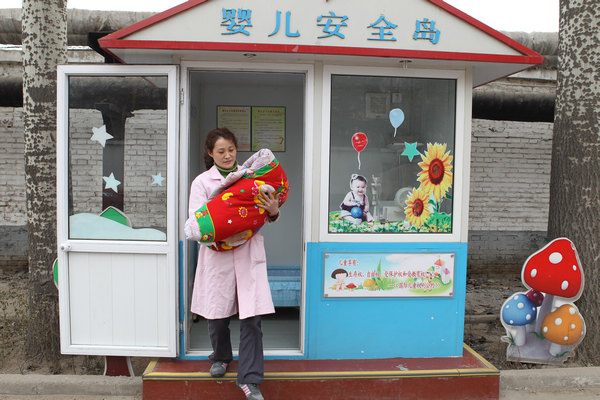
The safe haven, located outside the gate of Shijiazhuang Social Welfare Institute, is a cabin-shaped shelter designed to protect babies who have been left in the care of the institute.
Qin Bo, an official at the institute, explained its decision to set up the shelter.
|
 |
|
Yang Li, an employee of the Shijiazhuang Social Welfare Institute, carries a 1-month-old abandoned baby out of the "safe haven" set up by the institute on June 1, in Shijiazhuang, capital of Hebei province, on Thursday. [Feng Yongbin / China Daily] |
"For many years, infants were dropped off outside the gates of the welfare institute and the drop-off locations extended to streets 100 meters away," Qin said.
"We gave serious thought to what we could do to improve the situation, and that's how the safe haven was invented."
The safe haven, with an incubator and air extractor inside, cost the welfare institute 100,000 yuan ($15,900), but Qin believes the investment is well justified.
Many abandoned infants had birth defects or were seriously ill when parents abandoned them, mostly in the evening or at dawn.
"Some abandoned infants were ice-cold when we found them," Yang Li, who has worked at the institute for more than five years, said.
Yang said mosquito bites and wild animals were potential dangers to babies left on the street.
With the safe haven, babies can be left either at the incubator or in a crib inside. The bell rings after a delay of several minutes and then the institute's security guard comes to fetch the baby. The security guard also checks the incubator every two hours.
Once a baby has been left in the safe haven, staff members from the institute contact police to verify that the child has been abandoned. Later the baby will be sent to receive a health check.
According to Qin, the haven has substantially increased the chances of survival for the infants who have been dropped off there.
Their survival rate has increased from less than 50 percent to 66 percent.
The welfare institute's decision has created controversy among child welfare promoters and legal experts, some of whom say that the decision could encourage the act of infant abandonment.
"Some parents give up a baby girl because of gender discrimination or birth defects. Is it right to allow these selfish parents to give up their children?" asked Chen Wei, a lawyer from the Yingke Law Firm in Beijing.
Chen is worried that this kind of safe haven for abandoned children will encourage some parents to abdicate their legal responsibilities without good reason.
In response, Qin said that statistics from the institute showed that setting up the haven has not encouraged infant abandonment, and abandoned infants are not flocking into the institute.
According to statistics, the institute has received 75 abandoned infants, including 26 abandoned at the haven, since the haven was set up on June 1. There were 83 in 2010 and 105 in 2009.
"For parents, abandoning their babies is not an easy decision," Qin said.
"I don't think parents would decide to abandon babies simply because we set up a cozy temporary shelter. Most parents wouldn't do that even if we set up a haven with the standards of a five-star hotel."
Ji Gang, director of the domestic adoption department of the China Center for Children's Welfare and Adoption, believes the setting up of the haven is meaningful.
"It prioritizes a child's right to survive," Ji said.
"We can read at least one tragic story of abandoned babies in the media every week, and traditionally, abandoned children were dropped off on the street, in front of hospitals or even in toilets. Some died in freezing temperatures or from starvation. Others were harmed by animals," Ji said.






Hot Topics
Wu Ying, iPad, Jeremy Lin, Valentine's Day, Real Name, Whitney Houston, Syria,Iranian issue, Sanyan tourism, Giving birth in Hong Kong, Cadmium spill, housing policy
Editor's Picks

|

|
|
|

|

|