Private investment may bring more competition
Updated: 2012-03-01 07:46
By Wei Tian (China Daily)
|
|||||||||


BEIJING - Monopolized sectors may see more competition as China encourages private investment, amid expectations by experts that breakthrough policies are to be released soon.
Earlier this month, Premier Wen Jiabao reiterated that stimulating private investment and advancing reform in monopoly industries were the major tasks of this year's economic agenda.
Wen pledged that the government will make policy improvements to encourage private investments in monopolized fields, such as railways, finance, energy, telecommunications, education and healthcare.
The statement was made when the government was soliciting opinions on its work report, which is to be delivered at the upcoming annual session of the National People's Congress.
Wen also urged the government to draw up details of these supporting policies, known as the "New 36 Clauses" for private investments, within the first half of this year.
The "New 36 Clauses" refer to policies published in May 2010 to encourage and guide private investment.
The terms were a further refinement based on policies published in 2005, with more feasibility and details of implementation, according to the National Development and Reform Commission, which drafted them.
However, there are only a few regions, including Beijing, Guangdong, Zhejiang and Jiangsu, that have formulated detailed regulations accordingly to localize the policy. No major changes were made in monopolized industries, such as railway, energy and finance.
"Obstacles blocking private capital from entering monopolized industries have existed for many years," Zhou Dewen, chairman of the Wenzhou Small- and Medium-sized Enterprises Development Association, said.
Zhou's organization has been trying for a decade to start up a private bank in Wenzhou, the hub of China's private economy, using capital brought by overseas Chinese. But their submitted plans have been rejected repeatedly.
With monopoly remaining strong, 2011 has been a year of marked contrast for State-owned giants and private small- and medium-sized enterprises.
Struggling against a weakening global demand because of the debt crisis in Europe and the weak recovery of the United States, many private businesses have found themselves cornered by the stringent financial situation, resulting in many business owners fleeing or even committing suicide.
In contrast, many State-owned companies have been enjoying revenues which were "so high that we feel embarrassed to announce them", according to Hong Qi, president of China Minsheng Banking Corporation.
In fact, China's private economy has been contributing a major part to the Chinese economy, as the growth rate of private investment continued to accelerate.
According to data from the National Bureau of Statistics, private investment saw a year-on-year increase of 34.6 percent in the first 11 months of 2011, 2.2 percentage points faster than the same period last year.
The growth rate was 10.1 percentage points higher than the average of all types of investment, and has gradually become a main driver for investment growth.
However, little progress was made in monopolized industries for private investment.
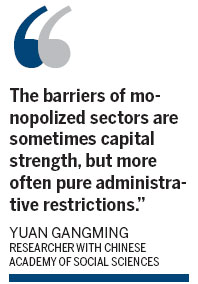
"The barriers of monopolized sectors are sometimes capital strength, but more often pure administrative restrictions," said Yuan Gangming, a researcher with the Chinese Academy of Social Sciences.
Once the thresholds are removed, it will provide more opportunities for more competitive companies, which will help boost the development of theses pivotal industries, Yuan said.
"And private enterprises will be very enthusiastic to enter these sectors because these monopolized areas are usually ones with high profits," he said.
Ye Tan, a noted financial columnist, said it is also essential for monopolized sectors to receive private investment, since many of them face funding shortages.
- China adopts new rules to combat pollution
- Charities open to religious groups
- Japan told to stop unilateral surveys
- DPRK to suspend nuclear activities
- China urges Japan to stop East China Sea research
- Chinese woman shot dead in Pakistan
- Monitoring of PM2.5 to be extended
- 17 Killed in N China factory blast






Hot Topics
Wu Ying, iPad, Jeremy Lin, Valentine's Day, Real Name, Whitney Houston, Syria,Iranian issue, Sanyan tourism, Giving birth in Hong Kong, Cadmium spill, housing policy
Editor's Picks
|

|

|

|

|
|