Tide of progress sees water levels fall
Updated: 2012-02-02 09:41
By Shao Wei (China Daily)
|
|||||||||


Another Lop Nur?
About 500 km away, a wilderness of white, saline-alkali land stretches from the edge of the tracks at Bole railway station, in northern Xinjiang's Bortala Mongolian autonomous prefecture. In the middle of the white lies Aibi Lake, Xinjiang's largest saltwater lake.
"It's not a good time to see the lake, as snow covers both lake and the land into white," train attendant Wang Lihong said. "Come here in summer, and you will see the beautiful lake and even swans from your train seat."
But Wang pointed at the distinct track of the lake's recession and said, "The lake turns smaller and is farther away from the rails."
Gao Xiang, director of the managerial administration of Aibi Lake Wetland Nature Reserve, said the lake is disappearing "at a drastic pace"- about 38 sq km a year. Desertification has claimed more than 1,500 sq km in recent years, reducing the lake area to 530 sq km.
"Now the lake has only one-third of its original size. Some experts predict it will become the second Lop Nur in the near future. I agree," he said. Lop Nur, between the Taklimakan and Kuruktag deserts in southeastern Xinjiang, disappeared 40 years ago.
"But what makes it more worrisome is that the dwindling of Aibi Lake will bring more damage to us than the Lop Nur," Gao said. It has become "a direct threat to the sustainable, economic development of northern Xinjiang".
 |
|
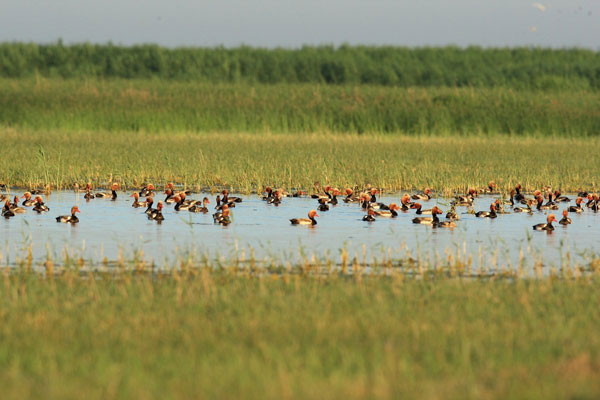
Wild ducks enjoy a comfortable summer in Aibi Lake. A wetland reserve was set up to try to save the lake. Provided to China Daily |








Hot Topics
Kim Jong-il, Mengniu, train crash probe, Vaclav Havel, New Year, coast guard death, Internet security, Mekong River, Strait of Hormuz, economic work conference
Editor's Picks
|

|
|

|

|

|