Getting to the root of it
Updated: 2012-01-10 07:35
By Guo Rui (China Daily)
|
|||||||||


 |
|
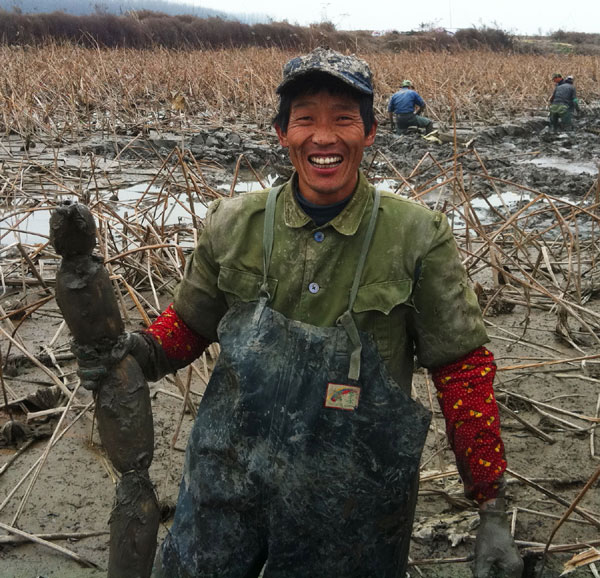
Liu Jigang displays a lotus root he just dug up in Hualian Lake in Wuhan, Hubei province. Guo Rui / China Daily |
WUHAN - It is cold enough outside in winter, not to mention standing in chilly water.
Yet for people like Liu Jigang, that is just a way of making a living.
Liu, 39, digs up lotus roots in the frigid winds of Hualian Lake, in Wuhan, Hubei province.
The Central China province boasts extensive planting areas of high quality lotus roots, and those in the industry have to work in the pond for more than eight hours a day in the cold season, from October to March.
"I have done this job for three years, my whole family is counting on my work," Liu told China Daily as he took a rest from digging up a lotus root.
His rough hands and the deep furrows lining his face belie his youth, and attest to the toughness of such labor.
Liu gets up at six every morning, downs a quick breakfast, and cycles to the lake about 40 minutes away.
He stands in the pond full of 40-centimeter-deep silt for about 10 hours, with a lunch break of about 30 minutes.
"Because the mud covers the lotus root, I have to walk a long muddy way to reach the places to dig in the marshy pond," Liu said.
It took him 20 minutes to move 15 meters the first time.
"The work needs both strength and skill," Liu said. "Once you know how to walk in the silt, you have to suffer standing half bent over for a long time and working in the chilly water."
Liu said the difficulty with digging is that people are not sure where the lotus roots might be.
Only withered lotus stems stand in muddy brown water, and the root is hidden under them, he said.
"You have to dig the mud near the stem first, then the water will flow in below," Liu said, as he dug down a meter and felt the root.
"Now you have to drop your scoop and pull the root by your hands," Liu said.
"It feels freezing cold at first, but I'm used to it," he said.
Liu's workmate surnamed Yao, 66, told China Daily that most of them will battle rheumatism after years of such work.
"The body will be soaked in the water for a long time and how many people can stand it?" said Yao, adding that the job is difficult but is still better than farming.
Diggers earn about 0.8 yuan (12 cents) for each kilogram of lotus root.
Liu makes 160 yuan each day from digging. In the busy season, he works 24 days a month.
"My nails always look dirty," he said. "My 18-year-old son once laughed at me, saying I could never wash my hands clean."
But those "unclean hands" have been raising a family of three people.
However, with excessive planting squeezing the profit margin for lotus root, sales are not as brisk as before.
Tian Huaqing, a subcontractor in Hualian Lake, said that they intend to turn the lotus pond into a crab farm in 2012. More than 100 diggers are facing unemployment.
"My greatest wish is to find a new job if I'm out of work in the future," Liu said hopefully, with the traditional Chinese New Year around the corner.