Side road to salvation
Updated: 2012-01-06 07:26
By Wang Hongyi (China Daily)
|
|||||||||


SHANGHAI - It was about a decade ago that Ji Qingying decided to take a different path to cure patients.
 |
|
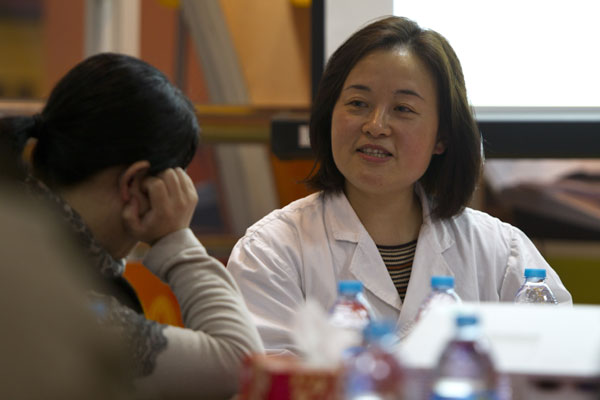
Ji Qingying, deputy director of the Shanghai Children's Medical Center, talks with parents of her patients. Gao Erqiang / China Daily |
"After years of work as a clinical doctor in pediatrics, I realized that what patients and their families frequently need are more than treatment of the disease," said Ji, the 47-year-old deputy director of the Shanghai Children's Medical Center.
"Most traditional treatments in hospital failed to rehabilitate, or ignored, those whose social functioning has been impaired," she said.
Now she is more willing to act as a medical social worker to patients.
After pursuing a master's degree in social work in Hong Kong in 2004, Ji established a social work department at the center.
"The learning process not only lighted me up, but also helped me understand how to give patients and their families the most care and help," she said.
Her workplace has been changed from one with cold operating tables to warm chatting rooms. But in her eyes, the work doesn't stray from her original goal of helping more people.
Medical social workers assist patients and their families to increase their capacities for problem solving and coping. They also help people obtain needed resources and mental supports.
The profession is little known in China although it plays an important role in medical practice. Only about 10 hospitals in Shanghai have an established medical social work department.
According to the Shanghai Municipal Health Bureau, the city is planning to carry out a pilot program to promote the development of medical social workers in the city's hospitals.
Patients at Ji's hospital are mainly children, as those with serious diseases often feel isolated and lonely because parents have to stay away and even stop phoning.
Ji and her two team members help reduce feelings of isolation through numerous support activities.
Once a girl patient wouldn't respond to the treatment and kept silent because she thought her parents had abandoned her.
Ji said the girl's parents did come to the hospital every day but were not allowed to see her because she needed to be isolated.
"So we told her that her parents love her very much, and asked her parents to write messages to their daughter," she said. "We also moved her bed near the window, where she could see the sun and blue sky, and not feel lonely."
At first, Ji and her colleagues' work was not accepted by patients and their families due to a lack of understanding. Now more people have begun to rely on them.
"About 85 percent of our patients are from outside Shanghai, and many of them are from rural areas," Ji said.
"It's their first time in a big city like Shanghai. They know nothing and need more help when facing a problem."
Ji and her team try to provide a platform where parents can talk, ease their nerves and pour out their anxieties.
In the hospital ward there is an elaborately decorated room, which is more like a room for recreation and playing. Here, Ji and her team organize regular group talks.
She said unlike group psychotherapy that treats emotional problems, the goal of group work is to help patients exchange information and help them deal with their problems.
"Though this cannot cure these patients' diseases, it really can help lessen their pressure," she added.
Ji's team also helps those from poverty-stricken families obtain adequate financial aids.
"I felt helpless when I first learned about my son's disease," said Jiang Peixi, whose son is suffering from aplastic anemia.
The father, from Anhui province, works as a security guard in Shanghai earning about 2,000 yuan ($317) a month. He and his wife had to clean out all their savings for treatment. So Ji's team has helped the family apply to a charity fund provided by the hospital.
"I feel very grateful and thankful to these medical social workers. Their support, financially and mentally, has relieved our pressure," Jiang said.