'Drought won't dry up the grain supply'
By Wu Jiao (China Daily)
Updated: 2011-03-11 08:35

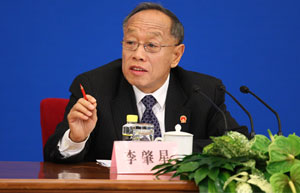
BEIJING - Despite the severe drought this winter, China is hoping to haul in another good harvest following seven successive record harvests of agricultural products, Agriculture Minister Han Changfu said on Thursday.
He made the remarks in response to international concern that China's grain harvest could be lower this year and that the country would need to import more as a result, triggering a hike in global prices.
| ||||


In addition to being the world's largest wheat producer, China is its largest consumer. The London-based International Grains Council has predicted that China will account for 17 percent of global wheat consumption this year by June 30.
Han sidestepped the question of whether China will import more grain this year.
Instead, he said this summer's wheat harvest benefited from recent rain and from massive drought-relief efforts.
"The primary goal of the ministry is to ensure the eighth successive strong harvest year," said Han, who added that the country has made food security its top goal.
Yet Han conceded that grain prices on the domestic market may rise moderately this year because of rising production costs and increasing demand. However, he said that there will be no significant price hike for grain-related products in China.
"No price hike is expected, given the fact that China has abundant grain reserves," Han explained.
China has benefited from seven successive record grain harvests during the past seven years, with the country producing an unprecedented 546 million tons in 2010.
The harvests guaranteed abundant grain supply and food security in China, he said.
Grain prices have been a primary concern of the Chinese government because the cost is an inflation driver and high prices could affect social stability.
China's consumer price index (CPI) rose 3.3 percent last year, breaching the government's target of a rise of no more than 3 percent. One-third of the rise in the CPI was attributed to rising food prices, which shot up by 7 percent in 2010.
Han said the government will regulate grain prices. He said it will try not to disappoint farmers by keeping grain prices too low but will also refuse to let the price of grain affect low-income residents in urban areas.
China is almost self-sufficient in grain, producing 90 percent of its requirements for its 1.3-billion population. The nation mainly imports corn and soybeans for edible oil, animal feeds and industrial bio-fuel.
Han stressed that the government will curb the non-food and non-feed use of corn, and especially its industrial uses.
Chen Xiwen, a member of the 11th Chinese People's Political Consultative Conference National Committee, called on the country to reduce its dependency on the global soybean market, noting that China now imports about 60 percent of the world's soybean exports.
China imported 42.6 million tons of soybeans in 2009, which was three times its national output. But in 2010, soybean imports soared to 54.8 million tons. It is expected that imports will exceed 60 million tons in 2011, according to Chen.