Fighting inflation to top the govt's economic agenda
By Wang Xiaotian (China Daily)
Updated: 2011-03-06 08:25

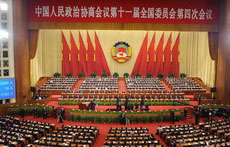
BEIJING - Premier Wen Jiabao put inflation control on top of the agenda for macroeconomic regulation and vowed to keep consumer price increases in 2011 at about 4 percent when delivering the annual government work report on Saturday.
He said the government would take a slew of measures, including administrative intervention, to further curb liquidity, broaden the supply of daily necessities and important materials, and prevent illegal behavior.
| ||||

"We must therefore make it our top priority in macroeconomic control to keep overall price levels stable."
He said the government would curb inflation by taking advantage of favorable conditions such as an ample supply of manufactured goods, abundant grain reserves and considerable foreign exchange reserves.
"We will endeavor to overcome the adverse effects of imported and structural inflation, cushion the upward pressure for costs of factors of production, and correctly guide market expectations to resolutely curb prices," he said.
The government would also provide subsidies to the low-income group to reduce the negative effects of surging prices.
The Chinese government has been increasingly concerned by consumer inflation since last year, as the consumer price index (CPI) rose to a record 30-month high of 5.1 percent in November. Some analysts predicted the figure would rise to as much as 6 percent in the first half of 2011.
In January, China's CPI rose to 4.9 with food prices the biggest contributor with a 10.3-percent surge.
The recent drought in major agricultural provinces and rising oil prices caused by turmoil in the Middle East have sparked inflation fears across the country.
Yan Qingmin, assistant chairman of the China Banking Regulatory Commission, said the official ceiling of 4 percent could be achieved if no dramatic natural disasters occur.
But Zhang Xiaoji, economist at the Development Research Center of the State Council, a key think tank for the Chinese government, predicted inflation for 2011 might be close to 5 percent.
"To soothe inflation pressure, yuan appreciation should be appropriately accelerated to reduce the effect of imported inflation," Zhang said, adding that a 5 percent increase to China's currency exchange rate would be well digested by the economy.
Zhang said a major cause of rising inflation was still excessive liquidity, and the government should limit further increases of foreign exchange reserves to mop up liquidity as well as tighten monetary policy.
To soak up excess liquidity in the economy and fight inflation, the central bank has raised the reserve requirement ratio for commercial banks eight times since the beginning of 2010 and hiked the benchmark interest rates three times.
"Inflation is a concern now but is expected to moderate in the second half of the year for a number of reasons," said Alaistair Chan, economist at Moody's Analytics.
He said the recent increase in retail fuel prices suggests that the government is cautiously optimistic that inflation can be controlled.