|
|||||||||||


The encroaching cities have also raked up psycho-socio problems.
With the loss of their arable land, farmers and rural workers find it hard to adapt to city life, not being equipped with the relevant skills for an urban environment. As a result, many suffer from distress and anxiety that no government aid can compensate.
|
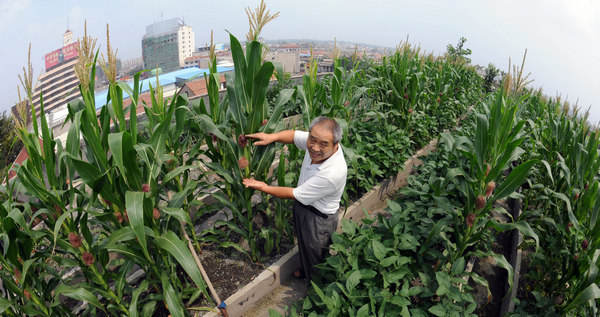 |
|
This happy rooftop farmer is a trendsetter, and if the "garden city" concept takes off, many more will reap the rewards of self-sufficiency in the city. Zhang Yanlin / for China Daily |
Last year in Beijing alone, there were 45 villages in Chao-yang district, 20 in Haidian, 30 in Changping and 64 in Da-xing slated for demolition, More than 60,000 rural residents had to be re-housed and compensated.
Li Zhi, a farmer from Chang-ying village in Chaoyang district, is among them. Together with more than 6,000 rural residents from 10 villages, Li moved to one of the new communities in Tongzhou district late last year.
"I lost my land and became rich overnight, but I can't find a job in the city. I feel so empty from day to day," Li says. He now keeps himself occupied selling fruit on the streets. Illegally, without a license.
It could have been worse. A relative of his lost 200,000 yuan ($31,600) - all of his compensation money - on the stock market.
Li says although the government and certain social groups from universities have initiated public courses to address and alleviate their financial and psychological stress, what they really want is to feel economically useful again.
There is also a matter of lifestyle, according to Li, because rural folks find it hard to adapt to city life.
"Moving to the cities, we are told not to grow vegetables, not to raise chickens in the community, not to leave things in the corridors, and so on and so forth because these habits may annoy our neighbors. But it's not that easy to change."
Keeping this in mind, architects at Urbanus designing the Technology Village in Changping district, Beijing, are focusing on ways to engage the rural-turned urban population and help them regain social status, and dignity.
"Above all else, we hope to leave the central green area for productive farmland, so that local farmers will be able to stay on the land and continue to earn their living," says Wang Hui, the chief architect.
For Wang, it was important to remember and be aware that millions of farmers have lost money, livelihood and lifestyle, and they should not be marginalized again socially, as insult upon injury.
"By keeping some space for farmland instead of cramming the landscape with scenic green zones, we give the farmers a buffer, buy them more time to learn and adapt to their new roles as urban dwellers," Wang says.
From another perspective, Liu Jiakun, an architect based in Chengdu, suggests that synergy between similar interest groups may be the answer - for example, a creative zone on the outskirts of cities for both artists and farmers.
Liu's inspiration comes from the success of the Lan Ding (Blue Roof) Art Zone, southwest of Chengdu in Sichuan province.
It started from a cluster of abandoned factories in 2003 which attracted four artists. Now, it houses a community of contemporary artists, of which there are about 100. Many of them are well known.
"People in the creative industry usually lead a SoHo (small office, home office) lifestyle, in favor of large, loft space, flexible working hours, and a free communicative atmosphere," Liu says. "By moving to the suburbs, they get it all, at lower costs."







Hot Topics
HIV/AIDS, Egypt protest, Thanksgiving, climate change, global economic recovery, home prices, high-speed railways, school bus safety, Libya situation, Weekly photos
Editor's Picks
|

|
|
|

|

|