Ear project 'genuine', university says
Updated: 2011-08-29 07:58
By Li Xinzhu (China Daily)
|
|||||||||||


SHANGHAI - The "human ear cartilage on a mouse back" project, once denounced as a scientific fraud, has been pronounced as genuine by experts and won international recognition, the Shanghai Jiao Tong University School of Medicine said in a press release on Saturday.
The project was carried out by Cao Yilin, a plastic surgeon who was rejected on Aug 17 as an academician candidate in the Chinese Academy of Engineering.
His former colleagues had accused him of irregularities involving about 300 million yuan ($46.2 million) in research funds and presenting a fake "ear mouse" on June 23.
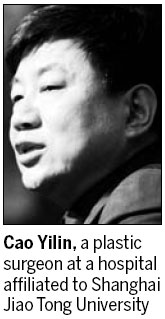
Cao denied the accusations and immediately began to repeat his experiment of regenerating human ear cartilage tissue on a mouse's back.
The rodent was widely known as the Vacanti mouse, a laboratory mouse that had a human ear-shaped cartilage grown on its back.
Within six week, Cao had successfully bred eight mice with human ears on their backs, and the entire process was filmed.
An investigative panel composed of academicians and experts in related fields tested and discussed Cao's results, and the panel soon concluded that Cao had achieved a genuine, mature technology.
Meanwhile, the Public Health and Medicine Audit Bureau of the National Audit Office sent investigators to Shanghai to examine Cao's research expenditures since 1999 and found no corrupt issue.
Cao produced a Vacanti mouse with an ear on its back at Harvard University in 1997.
Cao's work in tissue engineering and his efforts to apply the results to the fields of plastic and reconstructive surgery won him international fame.
He returned to China in the late 1990s and became director of the university's tissue engineering lab.
His research findings, including the ear mouse, were highlighted at a high-profile exhibition of China's scientific and technological progress held in 2001.
The goal of growing "human ears" on the backs of mice is to produce artificial organs for use in plastic surgery.
After Cao was listed as a candidate to be an academician in the Chinese Academy of Engineering, accusations about his work began to surface in print and online.
One of the accusers was Cao's postgraduate classmate and former colleague Shang Qingxin. In an interview with Oriental Outlook magazine, Shang said Cao originally made an ear using plastic and cow tissue.
"It was not a bad thing for others to question my research findings," Cao said at a press conference on Friday.
"But I can assure you that the ears on the backs of our mice were not made of plastic. I never cheated."
Cao said he was determined to give the research a practical application in medicine.
"Tissue engineering will ultimately solve many of the problems we face in plastic surgery. I wouldn't even mind experimenting on myself," he said.
The research findings could be used to grow jawbones, skin, joints and internal organs, he said.
Xinhua contributed to this story.






Hot Topics
Anti-Gay, Giant Panda, Subway, High Speed Train, Coal Mine, High Temperature, Rainstorm, Sino-US, Oil Spill, Zhu Min
Editor's Picks

|

|

|

|

|

|