China likely to begin importing more pork
Updated: 2011-08-18 07:41
By Jin Zhu (China Daily)
|
|||||||||||


BEIJING - China is expected to import more pork in the future if the domestic price of the country's staple meat continues to rise, experts said.
China's consumer price index, an important gauge of inflation, increased 6.5 percent in July above what it had been a year ago, according to the National Bureau of Statistics.
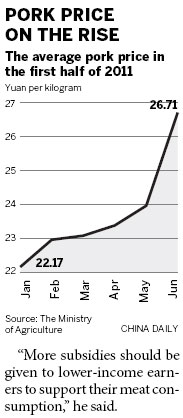
The inflation rate, driven primarily by increasing food costs, is at its highest point in 37 months. A big contributor to that increase has been the price of pork, which was nearly 57 percent higher in July than it had been a year ago, according to official figures.
|
 |
"The central government may consider importing more pork in the future, especially when the country has been harmed by long-term increases in pork prices," said Wang Jimin, deputy director of the Chinese Academy of Agricultural Sciences' agricultural economics and development institute.
"The country will continue to see high pork prices in the next few months of the year. Those will eventually be in line with the prices found in overseas markets."
Wang said foreign meat suppliers will enjoy a heyday in China when domestic pork costs more than imported pork.
"That's possible, but it's hard to predict now when that will exactly happen," he said.
Statistics from the US Department of Agriculture showed that US exporters sent 192,500 tons of pork and pork-related products to the Chinese mainland in the eight months leading up to February 2011. Those had a total value of $169 million.
During the same period, another 63,600 tons of the products were exported to Hong Kong, and most of that was then re-exported to the Chinese mainland, according to the US Department of Agriculture.
The amount of pork from the United States is expected to increase throughout the summer and possibly into next year, the agricultural department said.
Analysts blame the stubborn rise in pork prices in part on the shortage now seen in the domestic meat supply. That, they say, has been the result of many farmers' current reluctance to raise pigs.
An increasing number of rural residents are choosing not to cultivate their fields amid the rapid urbanization occurring around them.
"Farmers now are not willing to spend their time and money raising pigs, which is a rather dirty and hard job compared with working in cities," Wang said.
Making matters worse has been the spread of various severe pig diseases, which have dented farmers' incomes and forced many of them to give up raising pigs, said Liang Haoyi, a researcher at the China Animal Agriculture Association.
In July, the Chinese government introduced a series of fiscal policies meant to drive down pork prices and ease worries about inflation.
One of them will result in 2.5 billion yuan ($391 million) being invested into large-scale pig farms this year. Beneficiaries of the policy will receive a 100-yuan subsidy for each of the pigs they raise and 800 yuan in compensation for every pig that dies from disease or other external causes.
"There is still a long way to go if new large-scale pig farms are going to provide the country's meat supply, since many of them now don't have much experience in raising pigs," Liang said.
Wang has other ideas.
"More subsidies should be given to lower-income earners to support their meat consumption," he said.








Hot Topics
Rainstorms cause flooding in Gannan Tibet autonomous prefecture, Gansu province, on August 15, 2011.
Editor's Picks

|

|

|

|

|

|