China stocks dive amid US woes
Updated: 2011-08-09 07:05
By Li Xiang (China Daily)
|
|||||||||||


|
 |
|
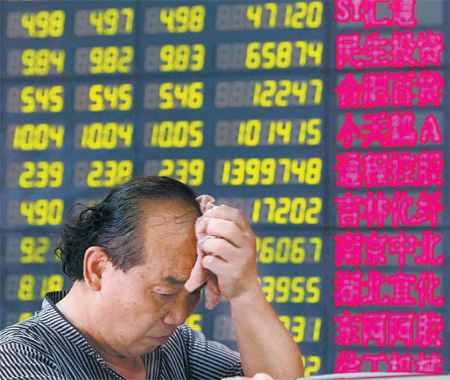
It was not just Shanghai's summer heat on Monday that caused brows to sweat. China's main share index ended down 3.8 percent, the biggest one-day decline since mid-November. The decline was fueled by a growing aversion to risk after Standard & Poor's downgraded the credit rating of the United States last week. [Photo/Agencies] |
Rating downgrade triggers panic sell-off as recession concerns grow
BEIJING - Chinese equities plunged on Monday as the US credit rating downgrade jolted financial markets amid fears that the global economy may be heading back into recession.
The benchmark Shanghai Composite Index suffered its worst decline in nearly nine months, falling 99.6 points, or 3.79 percent, to close at 2,526.82 points, the lowest level since July 2010.
Shipbuilding and textile manufacturing led the decline with more than 70 stocks falling to their daily trading limit of 10 percent. Stocks in steel, exports and natural resources also fell heavily. The index dropped below the psychologically important level of 2,500 points during intraday trading before regaining some lost ground.
Analysts said that the panic sell-off in the A-share market was directly triggered by the US downgrade on Friday, and it reflected Chinese investors' worries that the ongoing debt crisis in the US and Europe will lead to the second global recession since the financial crisis of 2008.
"The US downgrade has added to uncertainties putting pressure on the capital market. The first reaction of investors was to dump the risk assets before they could fully digest the impact of it," Ma Jun, chief economist for greater China with Deutsche Bank, said.
"The sentiment is likely to spread from the stock market to the real economy."
Investor confidence in the US economy suffered a major blow after international rating agency Standard & Poor's downgraded the rating for US sovereign credit from AAA to AA+. It has led to growing fears that the world's largest economy may default on its debt and lapse into a "double-dip" recession.
Asian stock markets tumbled on Monday with Hong Kong's Hang Seng Index falling 2.17 percent to 20,490.57 while Japan's Nikkei 225 stock average dropped 2.2 percent to 9,097.56.
European stocks also plunged. Britain's FTSE 100 index of leading shares was down 3.4 percent at 5,069 while France's CAC-40 fell 4.9 percent to 3,125. Germany's DAX index fell 5 percent.
The plunge in global stock markets came even after G20 policymakers issued a statement on Monday pledging to take coordinated action to shore up markets.
Some economists warned that a recession is increasingly likely as policymakers in the US and the eurozone are forced to cut fiscal spending to avoid defaulting.
"The US and Europe have been trapped in a vicious circle," Ma said. "If fiscal spending is tightened it will lead to a slowdown in the economy. But if they don't tighten, fears of potential default will cause turbulence in the financial markets, which will eventually spread to the real economy."
Amid the US downgrade, the dollar also dropped to a record low against the Chinese currency on Monday. The People's Bank of China set the official medium trading price of the yuan at 6.4305 against the US dollar, the highest level since Beijing initiated the exchange rate reform in 2005.
Economists said that the downgrade has substantially shaken investor belief in the greenback globally and US Treasury bonds as a risk-free investment option. It may also force holders of US government bonds, including China, to diversify dollar-based assets.
China has nearly $3.2 trillion worth of foreign exchange reserves, with about 70 percent of that in dollar-denominated assets.
"The trend of a weakening dollar has already become a certainty," said Guo Tianyong, director of the Research Center of the Chinese Banking Industry at the Central University of Finance and Economics.
"The biggest challenge for China is how to allocate its huge foreign exchange reserves."
China should end its dependency on the US dollar by halting any further accumulation of foreign exchange reserves, Yu Yongding, a former adviser to the People's Bank of China, said in a recent article in the Financial Times.
"The People's Bank of China must stop buying US dollars and allow the renminbi exchange rate to be decided by market forces as soon as possible," he wrote.
Although it is unclear whether the A-share market will continue to fall, Gui Haoming, chief analyst at Shenyin & Wanguo Securities, said the recovery of the stock market, in the long run, depends on containing inflation and asset bubbles in the domestic economy.
China's economy still faces inflationary risks, the problem of massive local government debt and spiraling property prices although policymakers are trying to shift the economy toward consumption and away from a reliance on exports.
Analysts said that it is almost impossible for the government to launch another stimulus package similar to the one in 2008, worth 4 trillion yuan ($621 billion), to tackle the global financial crisis.
Related Stories
Wall St sinks as fear jumps on historic downgrade 2011-08-09 06:33
China urged to stand pat on US debt 2011-08-08 16:57
HK economy safe from US credit downgrade: official 2011-08-08 16:32
Asian stock markets sink after US credit downgrade 2011-08-08 14:49
Time for US to stop blames, take responsibility 2011-08-08 06:52
Geithner slams S&P downgrade of US rating 2011-08-08 09:50








Hot Topics
Anti-Gay, Giant Panda, Subway, High Speed Train, Coal Mine, High Temperature, Rainstorm, Sino-US, Oil Spill, Zhu Min
Editor's Picks
|

|
|

|

|

|