Family planning policy to focus on quality of life
Updated: 2011-07-12 07:05
By Shan Juan (China Daily)
|
|||||||||||


TIANJIN - A major shift in China's family planning policy will result in a greater focus on population management than on quantity control, to improve people's quality of life, a leading official said on Monday.
Li Bin, minister of the National Population and Family Planning Commission, was speaking on Monday at an international event to mark World Population Day.
The global population is expected to pass 7 billion in October.
Another senior official endorsed the policy change as "revolutionary".
"The ongoing shift is significant and revolutionary," Zhao Baige, vice-minister of the commission, told China Daily.
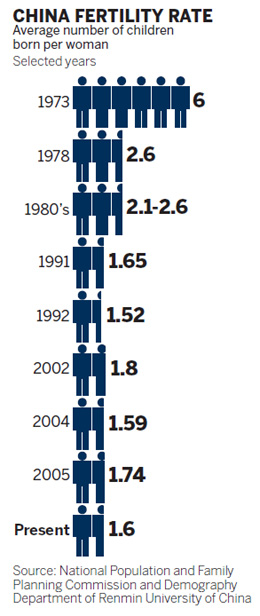
"We have to innovate in both our population strategy and its implementation" to tackle such emerging problems as urbanization, an aging population and declining fertility rates, she said.
Nobuko Horibe, director of the United Nations Population Fund Asia and Pacific Regional Office, said the policy shift is necessary.
"It is in line with China's changing demographics and national interest. I think China is now ready for the shift.
"Everyone has the right to live and to realize their potential. It is the government's responsibility to provide the people with suitable conditions," Horibe said.
Zhao said the shift, which highlights the importance of providing services, will see China better develop its human resources.
To help realize the goal, the commission has already expanded services from those concerning reproduction to after-birth health, early child development and giving young people access to mental healthcare.
Care for the elderly is also being boosted and public services for marginalized groups, such as migrants and families left behind in rural areas, are being provided.
"Our new task will cover issues concerning the population through different age stages. This is important for the development of the country and its people," Zhao said.
The commission has been trying to establish a professional team to deliver services to the public, taking advantage of its networks across the country, Zhao said.
However, given China's size and different demographics, "it takes years for the system to change its focus on providing services," Zhao added.
For the foreseeable future the sheer size of the population will remain a key factor in the nation's social and economic development.
"We'll fine-tune the family planning policy gradually," the commission's Li said.
Wycliffe Ambetsa Oparanya, Kenya's development minister, said China could share its experiences in population and development programs with other countries.
"There are 41 million people in Kenya and we don't have enough food to feed them. Without addressing the population issue our country can hardly develop," he said.
Kenyan women give birth, on average, to 4.6 children.
"People have to make sure they can support children, particularly in education, to foster quality population," he added.