Society
Cashmere industry needs technology help
By Wang Qian (China Daily)
Updated: 2011-06-27 08:06
 |
Large Medium Small |
NGARI, Tibet - Sheepherder Tsering Yangkyi spends her days and nights on lonely stretches of land near her Tibetan village driving 500 sheep with her family of nine.
Tsering lives in Deru village, Rutog county in Ngari prefecture, in the Tibet autonomous region.
|
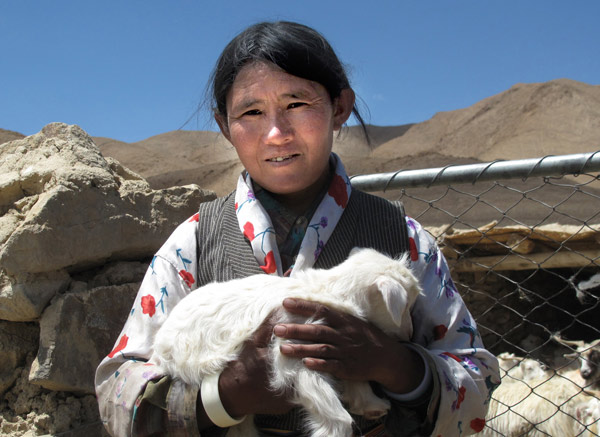 Tsering Yangkyi holds her new-born cashmere goat. [Wang Qian / China Daily] |
Her round-the-clock work increases her family's income from a few thousand yuan to more than 35,000 yuan ($5,147) a year.
Most income derives from cashmere and this pleases the whole family.
"Life has been much better than before, because the local government has subsidized the building of sheepfolds and houses to help us settle down," Tsering said in halting Mandarin.
The price for cashmere in 2011 is expected to increase to 300 yuan per kg, a year-on-year increase of 25 percent, Drubtob, the manager of the Rutog county cashmere goats' farm, told China Daily. This means Tsering's income this year will soar.
But compared with the reputation of cashmere as "soft gold" or "diamond fiber", the profits from feeding cashmere goats are still poor for the often-ignored herdsmen.
"The cashmere produced in Rutog is proven to be the best, with the purest blood and the thinnest fiber," Jamyang Tsering, deputy director of the information and press office of the Ngari prefecture, said.
"But because we don't have advanced processing technology, we can only sell the unprocessed cashmere to other places, such as Inner Mongolia. In the next five to 10 years, we will build our own cashmere brands."
Rutog's high altitude is ideal for producing the cloud-like wool, while the cold, dry winters cause the long-haired goats to grow rich coats to keep warm.
The soft fiber is spun into yarn and then knitted into sweaters, scarves and shawls sold by luxury brands in China and abroad.
According to the latest statistics from the Rutog county government, 308,000 cashmere goats and 850 high-quality sheep studs, are being fed at present. During the past five years, 72 tons of cashmere were produced, with a total value of more than 16 million yuan.
"If we could master the technology of making wool into cashmere products, we will make bigger profits," Jamyang said.
Tsering does not know where her wool goes and what it is made into. She has never been able to afford a cashmere sweater, which are generally worth about 2,000 yuan in the current market.
China is the world's largest producer of cashmere, churning out about 66 percent of the global supply.
According to statistics from the General Administration of Customs, from January to July 2010 exports of cashmere products reached about $553 million, with a year-on-year growth of 25 percent.
Facing such a big domestic and foreign market, Cheng Xinming, deputy director of the commercial and trading bureau in Ngari prefecture, is also very interested in the industry.
"But we do not have our own processing factories, so we have to depend on other manufacturers," Cheng sighed, adding that the current output of white cashmere in Rutog can only meet domestic demand.