Government and Policy
Ministry denies lower dairy standard
By Zhou Wenting (China Daily)
Updated: 2011-06-27 07:59
 |
Large Medium Small |
BEIJING - Chinese officials have denied adopting a looser national standard of milk quality and claim to be developing grading levels for raw milk to guide the production of differentiated products.
In response to recent reports that China's dairy industry has the world's lowest standards, the Ministry of Health said the new standard for the maximum limit of bacteria in raw milk is stricter than before.
According to a notice issued by the ministry, the original standards of bacteria counts consisted of four grades, from 500,000 per milliliter to 4 million per ml instead of the one standard of 500,000 per ml reported by media.
"The new milk quality standards implemented in March 2010 adjusted the standard to 2 million, which is more stringent than before, and has raised the threshold for raw milk," Meng Jin, a member of the working group of experts on dairy safety standards, said in the notice.
In response to the criticism that the minimum requirement for protein content had been lowered from 2.95 grams per 100 g of milk to 2.80 g, the notice attributed the change to the ministry's survey result that 90 percent of raw milk produced in North China in 2008 was below the standard of 2.95.
"The survey data comes from 2008, when the melamine-tainted baby formula scandal broke. The proportion of qualified raw milk should have increased a lot by now," Wang Dingmian, chairman of the Guangzhou Dairy Association, told China Daily on Sunday.
According to the notice, compared with the 2.80 standard for protein content in raw milk, the indicator in pasteurized milk and sterilized milk must be no lower than 2.90.
Industry experts said the widely taken approach of manufacturing milk products of higher protein content with raw milk of lower protein content is done by artificial post-processing.
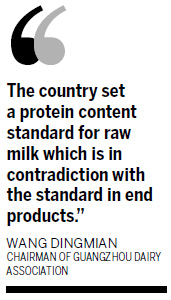
"The country set a protein content standard for raw milk which is in contradiction with the standard in end products. It shows the country permits the adding of material and is forcing dairy firms to cheat," Wang said.
"And the added material cannot be milk protein derived from other raw milk. In most cases, it is protein powder."
Food safety experts said allowing the addition of material may pose dangers to milk security.
"The 2008 melamine-contaminated baby milk scandal was precisely caused by dairy firms adding the chemical into watered-down milk powder to cause it to appear to have a higher protein content," said Sang Liwei, a food-safety lawyer and the China representative of the NGO Global Food Safety Forum. That year, nationwide outrage exploded over the dangerous milk that made 300,000 infants sick and killed six children, who died of kidney stones and other kidney damage.
Wang Zhutian, deputy director of the Fortified Food Office under the Chinese Center for Disease Control and Prevention and the leader of the working group of experts on dairy safety standards, said in the notice of the ministry that they are tracking and evaluating the implementation of the national dairy safety standards and will make appropriate improvements.
The ministry also encourages dairy firms to purchase raw milk with a flexible policy to pay high prices to farmers for high-quality milk and to set grading standards for bacteria counts when buying raw milk.