Society
Badge of honor in the New China
By Zhu Linyong (China Daily)
Updated: 2011-06-25 08:50
 |
Large Medium Small |
|
 |
|
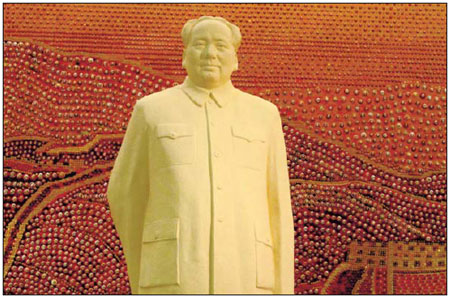
A 4-meter-high marble statue of Chairman Mao, created in 1968, was a model for many of the Mao statues made in the 1960s and 1970s. |
The museum's exhibits are arranged roughly in chronological order to offer a glimpse of the history of the Communist Party of China (CPC), the founding of the People's Republic of China and unprecedented achievements of the Chinese people over the past three decades.
The larger and heavier Mao badges are displayed in 38 showcases, and a multitude of Mao badges are used to create huge collages depicting historically significant sites and scenes. These include portrayals of the wooden ship where the first meeting of the earliest CPC members was convened on South Lake in Jiaxing, eastern Zhejiang province, in 1921; Mao's declaration of the People's Republic of China on Oct 1, 1949, at the Tiananmen Rostrum; the launch of the Shenzhou VII spacecraft on Sept 25, 2008; and the iconic structures of the 2008 Beijing Olympics and 2010 Shanghai Expo.
Several other collages portray impressive Chinese scenic locations, such as the Hukou Waterfall on the Yellow River in Yichuan county, Shaanxi province, and Victoria Harbor in Hong Kong.
But the most striking collage of all is probably the one at the museum's entrance with a panoramic view of the Great Wall.
The collage, 5 meters high and 26 meters long, was made with 189,300 Mao badges of different shapes, sizes and materials. It is the largest collage of its kind in the world.
In front of that immense artwork is a massive, 18 ton, natural lingbi stone that resembles the geographic formations of the Yuanjiagou Valley, near Yan'an, the central point of the Communist Party's revolutionary base, led by Mao during the War of Resistance against Japanese Aggression (1937-1945).
Standing between the collage and the stone, is a 4-meter-high marble statue of Chairman Mao, which was created in 1968. It was a model for many of the Mao statues made in the 1960s and 1970s, according to Li Xia, the museum's director.
Other exhibits bearing Chairman Mao's images include alarm clocks, dishes, teapots, spoons, colored posters, embroidered wall hangings, woodblock prints, statuettes made of clay, bronze, iron, plaster, aluminum and plastic, and the Little Red Books - various editions of the collection of Mao quotations that were popular among youths during the "cultural revolution" (1966-1976).