Government and Policy
No asset declaration timetable for officials
By Yan Jie (China Daily)
Updated: 2011-06-23 06:57
 |
Large Medium Small |
'Proper environment' must be in place before introduction of system
BEIJING - The top anti-graft body of the Communist Party of China (CPC) said on Wednesday that it has no timetable to implement the much-anticipated asset declaration system for officials due to technical reasons.
|
||||

One would cover social credit, information such as loan and credit history, and the other would highlight personal information. Both needed to be up and running before officials were required to disclose private assets to the public.
|
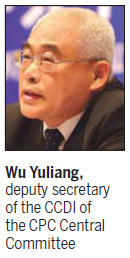 |
"Any good system has to have accompanying measures and a proper environment to become feasible," Wu said at a news conference, adding that it will be difficult to implement the system in China without the two mechanisms.
He said the public will not trust accounts provided by officials if they don't have access to relevant statistics.
Wu, however, said asset declaration was a common part of anti-graft measures in many countries and had proved effective. "We are confident about setting up such a system," Wu said.
According to the CPC Central Committee's anti-corruption guidelines for 2008-2012, the Party will accelerate research and evaluation to set up the system.
A regulation issued last year requires leading officials to report personal income, the employment status of children and spouses as well as their property interests and investments, Wu said.
Leading officials are specified as those holding deputy-county level positions or above in Party organs, legislatures, governments and other institutions.
Some 1.67 million officials across the nation filed asset reports to Party organizations in 2010, according to a document distributed at the news conference.
Property ownership was reported by 851,353 officials, 606,813 reported their investments, and 805,269 reported the employment status of their children and spouses.
|
 |
Problems with 1,581 officials had been rectified, the document said.
Some local Party departments began to order officials more than two years ago to disclose private assets.
Lin Zhe, a professor of anti-corruption at the Party School of the CPC Central Committee, said it will be a long time before officials' assets are in the public arena.
"The public in China have no way of learning about officials' personal assets because those details are only reported to the Party," Lin said.
Lin recommended that the government first try revealing officials' assets among officials of the same rank. The next step would be to expand the circle of people, and so on.
The public generally support the idea of introducing such a system and the Party's push to upgrade supervision of officials.
The CPC Central Committee and the State Council promulgated a regulation in April 1995 that requires high-ranking officials to declare income.
But some corrupt officials transferred their illegal gains overseas, to spouses or children, to avoid punishment.
Asset declaration will help prevent corrupt officials from fleeing the country and transferring embezzled funds and bribes abroad, Wu said.
Some officials have exploited investment immigration policies to acquire foreign citizenship and move their wealth, he added.
Chinese officials and top company executives tended to transfer assets through at least eight routes, including cash smuggling, underground financial institutions and offshore financial centers, according to a report filed in 2008 by the Anti-Money Laundering Monitoring & Analysis Center of the People's Bank of China. The report drew huge public attention in China.
Wu warned that rapid social and economic changes have made China "prone to corruption" and the CPC faces a major challenge stamping out deep-rooted graft.
"The situation remains severe and we have a daunting task in front of us."
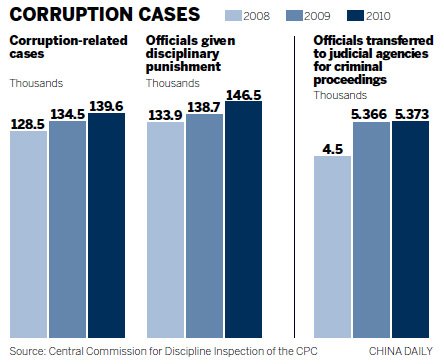
Discipline inspection commissions investigated 139,621 corruption cases last year, according to statistics from the CCDI.
A total of 146,517 people were given disciplinary punishment and 5,373 transferred to judicial agencies for criminal proceedings in 2010.
When asked about the case of former railways minister Liu Zhijun, who was sacked in February over allegations of wrongdoing, Wu said the case is under investigation.
The result of the case will be made public when the investigation is completed, he added.
Xinhua contributed to this story.