Society
Beijing to Shanghai speed to hit 350km/h
By Xin Dingding (China Daily)
Updated: 2011-06-16 08:04
 |
Large Medium Small |
|
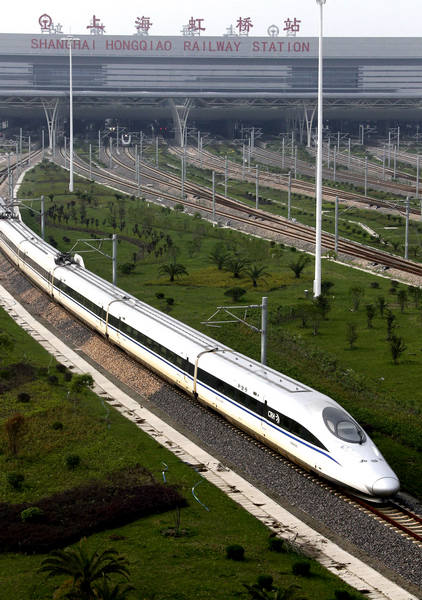 A CRH380B high-speed train departs Shanghai Hongqiao Railway Station on Monday. [Photo / Xinhua] |
BEIJING - The operating speed of the much-anticipated Beijing-Shanghai high-speed railway is likely to reach 350 km/h in the future, said a senior railway official.
Zhai Jianguo, chief accountant with the Beijing-Shanghai high-speed railway company, said on Wednesday that in 2007 the National Development and Reform Commission (NDRC), the country's economic planner, set 300 km/h as the operating speed for the line's first year of service.
|
||||


Zhai explained that setting a one-year initial stage is a common practice, as the rail track must be tested over four seasons, including floods in summer and snowfalls in winter. At the end of that stage, the central government will check the line and decide whether to accept it.
"By then, we say a rail line starts formal operations," he said. "And we will reassess how many trains a day to run on the line as well as the speed for its formal operation, based on the one-year results and how well the public accepts the line.
"The possibility of running trains at 350 km/h on the line has not been excluded."
The initial stage's operating speed of 300 km/h, which is lower than expected, also has nothing to do with the quality of the project, Yang Qibing, deputy chief commander of the Beijing-Shanghai high-speed railway construction headquarters, said on Wednesday.
Yang also said the railway's construction time had not been shortened and that the milestone project had not sacrificed quality to meet a tighter construction schedule. Originally, the railway was due to open in 2012.
Yang explained that initial estimates said the line's construction would take five years, because the Dashengguan Bridge in Nanjing over the Yangtze River would take five years to build. But for the major part of the line, construction time was expected to take three and a half years.
The fact is, the construction of the Dashengguan Bridge had started at the beginning of 2006, two years before that of the major part of the Beijing-Shanghai high-speed railway, and the bridge was opened in January this year.
Work on other parts of the railway started at the beginning of 2008, a few months ahead of the ceremony on April 18, 2008, marking the start of construction of the Beijing-Shanghai high-speed railway, he said.
"The actual time of the railway construction has not been shortened," Yang said, rejecting claims that the project's construction time had been reduced to meet an advanced deadline and that this might have affected the quality of the work.
In fact, tests and checks have shown the landmark railway's quality is good.
For example, 55,585 concrete-strength tests on bridges, tunnels and culverts along the line have all passed checks conducted by the country's best laboratory in that field, he said, refuting earlier media reports that questioned the quality of concrete used in high-speed railways.
Fly ash is a glass-like powder used to improve the strength of concrete. After it was found that substandard fly ash was being used in part of the Guiyang-Guangzhou high-speed railway, some media reports said there might not be enough quality fly ash to meet demands generated by the large high-speed railway projects in China.
Also, foundation piles for railway bridges that account for 80 percent of the railway's 1,318 kilometers have all passed checks conducted by a third party, Yang said.
The Beijing-Shanghai high-speed railway's infrastructure, including bridges and culverts, have a designed life span of 100 years, and this can be guaranteed, he added.