Taiwan
Healing the split: Culture cures
By Eric Jou (China Daily)
Updated: 2011-06-12 08:18
 |
Large Medium Small |
Many of China's best examples of cultural heritage are separated by the Taiwan Straits, but now, museum curators on both sides hope their isolated collections may finally be united with their companion pieces, Eric Jou reports.
After a separation of more than 360 years, Huang Gongwang's famous Dwelling in the Fuchun Mountains (富春山居圖) has been made whole again in Taipei. The two sections of the historic landscape scroll were reunited for a special exhibition at the Palace Museum in Taipei and will be on show from June 1 to Sept 5. The entire exhibition was facilitated by loans from six different mainland museums. "The exhibition is a culmination of cooperation from the Shanghai Museum, Beijing Palace Museum, the National Museum of China, Nanjing Museum, Zhejiang Provincial Museum and the Yunnan Provincial Museum," says the director of the Taipei National Palace Museum, He Chuanxin. "The showcase will feature various treasures, but the focus is the unification of the Dwelling in the Fuchun Mountains."
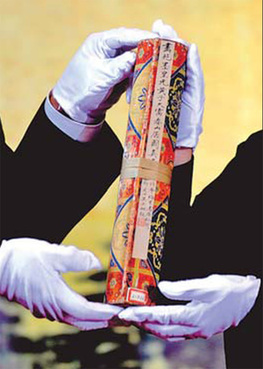 Dwelling in the Fuchun Mountains: The historic handover and cooperation marked a milestone for China's museum curators. Liang Zhen / Xinhua |
The unification of the Dwelling in the Fu-chun Mountains is not the first such to be held in Taipei, and it will certainly not be the last in the current climate of friendly cooperation. In recent years, cultural exchange between Taiwan and the mainland has increased significantly and curators are hopeful it will continue.
"In the past, we'd borrowed some exhibits from Beijing (Palace Museum) and other mainland museums and they were well received," says He. "There are other future projects planned, one being the joint exhibition on the Emperor Kangxi, with more pieces borrowed from Beijing."
Many Chinese artifacts and treasures are split between museums in the mainland and on the island following the Kuomintang (KMT)'s exodus to Taiwan. It is commonly acknowledged that "the Beijing Palace Museum is the building and the chest, whereas the Taiwan Palace Museum holds all the treasures".
Of the priceless museum items separately held in Taipei and Beijing, many are incomplete collections waiting to be reunited such as the Dwelling in the Fuchun Mountains, Three Rare Calligraphy Scrolls (三希堂法帖) and River Scenes During Qingming Festival (清明上河圖).
According to He, there are plans to reunite and exhibit as many as possible. So far, however, the reunions have only been held in Taipei, the reason being mainly political, and stemming from the strain in cross-Straits relations. Mainland museums are now more willing to loan artifacts in the name of cultural unity.
Marc Wilson, Director Emeritus of the Nelson-Atkins Museum of Art in Kansas City, Missouri and a former assistant curator at the Taipei Palace Museum, says that the paintings are secure and safe in Taipei. Wilson's own museum in Missouri had loaned works of art to the Taipei Palace Museum and he is no stranger to its security practices, having worked at the museum himself. He rates these along the top museums in the world.
"About four years ago my museum lent incomparable treasures to an exhibition of Northern Song painting and calligraphy," says Wilson. "The security precautions and procedures were the strictest I have ever seen, far surpassing practices at major museums in Europe or in the United States.
"The Taipei Palace Museum has certainly set the bar internationally in terms of standards and practice."
But, the cultural exchange is still tilted towards the island, with Taipei benefitting more from the arrangements.
Jiang Min-Chin, Professor of Public Administration at Taipei University, says that the cultural cooperation is part of warming relations in a complicated cross-Straits situation.
Jiang, a frequent commentator on cross-Straits relations on the CCTV television show Straits Talk, says visitors from the mainland feel that the treasures are already their own and are interested in seeing how they are kept and maintained during their years of separation in Taiwan.
"The average mainland visitor feels these treasures are already theirs, and that Taiwan is just holding on to them after the KMT removed them from their home," says Jiang.
"There is still a sense that Taiwan is forbidden territory, that its society is different from the mainland and so they come with a sense of novel curiosity, waiting to see how culture has developed here. When they come to Taiwan it isn't just about the sightseeing. Alishan is pretty but it doesn't compare to Huang Shang. What attracts them to Taiwan is the human element."
Jiang speculates that there will be more museum exchanges on the horizon and that warming ties between the mainland and Taiwan will benefit both the people and the culture.
"In the end, it's about unifying history," says Jiang. "Cross-Straits cooperation is like a bridge over troubled waters, it will help future generations understand our history."
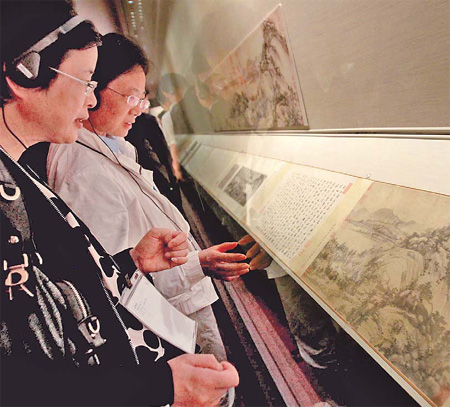 Dwelling in the Fuchun Mountains: The historic handover and cooperation marked a milestone for China's museum curators. Liang Zhen / Xinhua |