Society
Survey: charities need more transparency
By He Dan (China Daily)
Updated: 2011-06-08 07:34
 |
Large Medium Small |
Beijing - About 70 percent of netizens believe that legitimacy, transparency and honesty are essential for anyone doing charity work, according to a recent survey.
 |
|
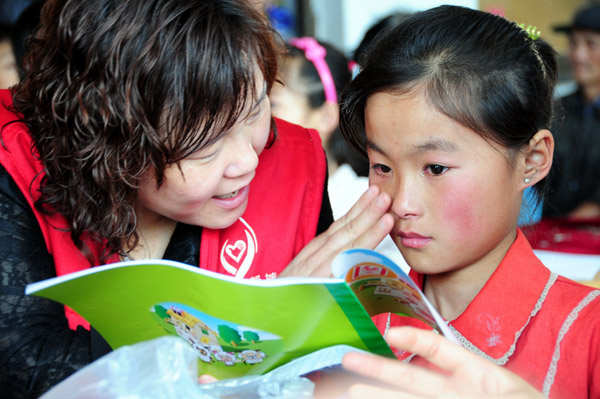
A woman wipes away the tears of a pupil in a primary school in Tancheng county of Linyi city, East China's Shandong province, on May 29. About 40 netizens donated money and gave gifts to the school's 34 pupils who come from poverty stricken families. [Fang Dehua / for China Daily] |
The survey, conducted by China Youth Daily, also showed that about 47 percent of the respondents think that philanthropic donations should not be used as a tool for individuals or enterprises to make money or improve their image.
The online survey polled some 5,600 people, 80 percent of whom were aged between 20 and 50.
However, experts think it is acceptable for companies to treat philanthropy as a public relations strategy unless they abuse people's generosity or engage in fraud.
"It's normal for companies and philanthropists to be motivated to do charity activities out of commercial interests or for intangible benefits," Xu Yongguang, secretary-general of the Narada Foundation, told China Daily on Monday.
The intangible benefits for donors include establishing a good reputation among consumers or receiving favorable policies from government departments, Xu said.
But more and more people in China are now choosing to raise funds for those in need via micro blogs or online.
|
||||


But respondents to the China Youth Daily survey revealed concerns about this kind of micro-philanthropy.
More than 54 percent of those surveyed worried that "the donated money cannot be effectively supervised", and nearly half of the respondents said some micro-philanthropy programs might manipulate people's kindness for personal gain.
Meanwhile, about 44 percent felt fundraising by individuals created more opportunities for fraud and economic crimes.
But Liang said, "I almost lost my life when our car turned over during traveling on a mountain road in Guizhou province, when we were choosing schools for our free lunch program."
"It's really unfair to assume that we do this voluntary work for personal fame and gain," Liang told China Daily in a telephone interview.
Deng Guosheng, director of the NGO Research Center at Tsinghua University, said the government should strengthen its management and supervision of individuals raising funds online in order to maintain the credibility of China's philanthropic cause and ensure that people in need receive help.
In recent years, the public's enthusiasm for charitable donations has been adversely affected by a number of scandals.
In February, Pan Kaihong, 43, was elected deputy director of the Nanjing Charity Federation after donating 30 million yuan to the organization last year, but he was later arrested by the police and charged with illegally collecting more than 51 million yuan from local residents since 2010.