Society
Damaged masterpiece restored to give the full picture
By Ma Zhenhuan (China Daily)
Updated: 2011-06-02 09:08
 |
Large Medium Small |
|
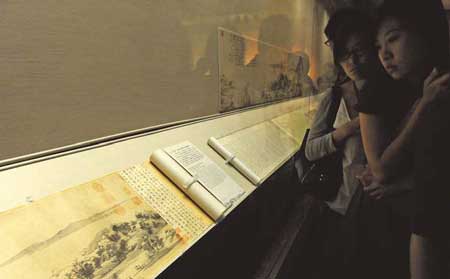 Visitors look at the Fu Chun Shan Ju Tu which is on display at the Palace Museum in Taipei on June 1. Huang Shulin / Zhejiang Daily |
Fu Chun Shan Ju Tu is the most representative ink-and-wash painting of Huang Gongwang (1269-1354), one of the "four great masters of the Yuan Dynasty (1271-1368)".
Based on the landscape of the Fuchun River in Zhejiang province, where Huang lived in his twilight years, Huang took three years to finish the work. The 82-year-old then gave it to Taoist monk Wu Yongshi.
Dong Qichang (1555-1636), the renowned Ming connoisseur who once owned it, described looking at it as "feeling completely satisfied".
Huang could never have imagined that nearly 300 years later someone would want to destroy his masterpiece not out of rage but out of love.
Crazed fan, Wu Hongyu, was a Qing Dynasty (1644-1911) collector. Enthralled by the masterpiece, he hoped that by burning the painting it would accompany him forever in the afterlife.
Luckily for the Fu Chun Shan Ju Tu, the minute the painting was thrown onto a fire, his nephew, Wu Jiang'an rushed to save it. But the damage had been done. The more-than-6-meter-long scroll was torn into two pieces.
The pieces were given separate names and remained apart. The first and smaller piece, measuring a bit more than half a meter, was renamed Sheng Shan Tu, or The Remaining Mountains. After passing through several collectors, it is now housed in the Zhejiang Provincial Museum.
The longer piece, Wu Yong Shi Volume, had a more dramatic journey.
In 1746 the piece was acquired by the Imperial Palace.
But the emperor Qianlong ascertained it to be a high-quality fake, as a year earlier he had bought a painting he believed was the authentic Wu Yong Shi Volume.
To save the Qianlong emperor, who considered himself an exceptional connoisseur, from losing face, the real one was designated a fake until 1816. And the actual fake, which had earned 48 poems from Qianlong, was proven to be a copy by renowned Ming (1368-1644) artist Shen Zhou (1427-1509). The fake was later known as the Ziming Volume.
Wu Yong Shi Volume was eventually taken to Taiwan after the Kuomintang lost the War of Liberation and is now kept in the Palace Museum in Taipei. On May 18, Art Exhibitions China and the Palace Museum in Taipei held a handover ceremony for Sheng Shan Tu - the smaller piece - in Beijing. In June and July, the two pieces will be exhibited together as one at the Palace Museum in Taipei.
After 360 years, the grand masterpiece can finally be viewed whole again.