Government and Policy
Demand for plastic bags remains strong
By Zheng Jinran (China Daily)
Updated: 2011-06-02 08:12
 |
Large Medium Small |
|
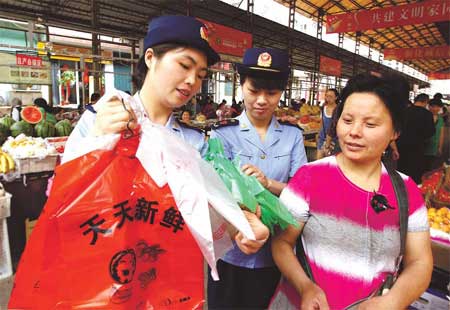 Law enforcement officers from the local industry and commerce bureau inspect plastic bags at an open market in Huaibei, Auhui province, on Tuesday. [Li Xin / for China Daily] |
BEIJING - The decision to outlaw the free distribution of plastic bags at shops and supermarkets in an attempt to protect the environment is still a hot topic three years after the ban came into effect, according to industry insiders.
China introduced the ban on free plastic bags on June 1, 2008 and also ordered producers to no longer make bags that are thinner than 0.025 millimeters.
According to some producers, the ban has hit plastic bag factories hard.
"About 90 percent of my factory's production was lost after the new law came in," said Ma Fusheng, manager of Beijing Hongguang Plastic Factory. "Many shops didn't need as many plastic bags because few customers wanted to buy them."
Ma said production slumped from 5 million plastic bags a day in 2008 to the current 500,000.
"And I had to cut 150 workers from my staff during the past three years because I cannot afford to employ them," he said.
But Ma said that while few people these days want conventional plastic supermarket carrier bags there is still a strong demand for illegal ultra-thin plastic bags, even though studies show they may be harmful to people's health. He estimated that about 50 tons of such plastic bags - thinner than 0.025 mm - are used in the capital every day.
A survey said that about 70 percent of plastic bags used in outdoor markets in Beijing are substandard products and mainly ultra-thin plastic bags.
The survey was released by the International Food Packaging Association on May 23 after it analyzed 10 supermarkets and 10 outdoor markets between April and May in Beijing.
"It's very hard to stop vendors from using ultra-thin plastic bags, since they are much cheaper and more in demand," said Chen Jingming, manager of the Dongjiao Wholesale Market in the Chaoyang district of Beijing.
"So, we had to adopt strict measures to combat their use and are cooperating with the local authorities."
He added that vendors at the market can be fined up to 20,000 yuan ($3,100) if they are found using substandard plastic bags. So, far, seven vendors have faced such punishment and gone out of business.
The survey found that all 10 supermarkets looked at were not breaking the rules and were selling, instead of giving away, plastic bags. But it said the ban was not effective in protecting the environment because most customers were tending to pay for the bags, instead of using recyclable ones.
"About 9 million plastic bags were used in our stores in 2009, a 100 percent increase on the number used in 2008 when the ban was started and, in 2010, about 8.9 million were used," said Zhao Meng, from the operations department at Beijing Chaoshifa Chain Store Co Ltd. The supermarket chain has more than 70 stores in the capital.
"More customers choose to buy plastic bags because they are convenient and only a few housewives and seniors are prepared to use their own bags when shopping."