Economy
Growing pains of China's wind power industry
(Xinhua)
Updated: 2011-05-28 20:59
 |
Large Medium Small |
|
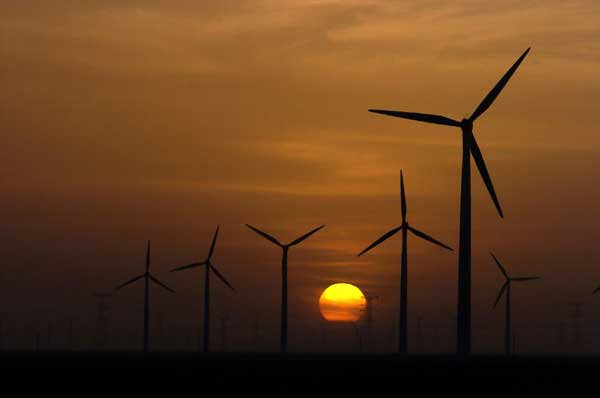 Wind turbines can be seen in the sunset glow at a wind power base in the Jiuquan city, Northwest China's Gansu province, May 15, 2011. [Photo/Xinhua] |
BEIJING - In a vast prairie to the north of Hohhot, the capital city of North China's Inner Mongolia autonomous region, hundreds of wind turbines stand like a vast, unbroken forest.
The turbines have created both opportunities and problems for the region's power companies.
"I long for wind, but I also fear wind," says Su Changyou, a manager of a wind farm located in Inner Mongolia's Siziwang Banner (County).
|
||||


Ever since Su's wind farm was connected to China's power grid last May, only about 60 percent of the farm's turbines have been in operation. The rest of the turbines must remain idle to avoid overloading the grid.
Qi Laisheng, general manager of the Inner Mongolia subsidiary of Longyuan Power, China's largest wind farm operator, says "these things happen all the time here. About a quarter of the turbines on my wind farm have to remain idle, even on the windiest days."
Grid access has become a nightmare for Inner Mongolia's burgeoning wind power industry. Wind farms in the region have a total installed power capacity of 6.5 gigawatts (GW), the most of any region in China.
China surpassed the United States to become the world's largest producer of wind power at the end of 2010. However, China's wind power industry has been troubled with growing pains.
Under China's Renewable Energy Law, which was created in 2005 and amended in 2009, wind farms that are connected to the country's power grid must be constructed with prior approval from the government.
The State Grid Corporation of China (State Grid) and the Inner Mongolia Grid, an independent provincial power grid, have ensured that all of the wind turbines connected to their power grids are government-approved. However, they cannot allow all of these turbines to operate simultaneously.
One reason for this is the fluctuating nature of wind power. Some industry officials believe that wind power may pose a serious threat to power grid stability, saying that wind power should account for less than 5 to 10 percent of any given power grid's total power. However, on April 8, 2010, wind power accounted for 18.7 percent of the Inner Mongolia Grid's total power without any negative repercussions.
A great deal of wind power is wasted during the winter season, when thermal power generators are used to supply heat for most of Inner Mongolia's residents. The Inner Mongolia Grid prefers to use thermal power generators because they can generate electric power while simultaneously creating steam, which can be used to heat homes and businesses in the region.
Tao Ming, director of the Siziwang Banner wind power office, says "during the winter, the grid gives priority to generating power with thermal power generators. Inner Mongolia has relatively low demands for electric power because of its underdeveloped industries. Thermal power plants can work at full steam, while wind turbines have to remain idle."
The Inner Mongolia Electricity Council says that wind farms connected to the Inner Mongolia Grid lost several billion yuan in 2010 because of idle turbines.
Northwest China's Gansu Province has not fared much better. Only 68 percent of the province's turbines, which are connected to a wind power base in the city of Jiuquan, are continuously generating power, according to the Jiuquan municipal energy bureau.
According to a February report by the China Electricity Council (CEC), about one-third of China's wind turbines are idle, a sign that China's wind power industry has some serious problems to solve.
BOTTLENECKED POWER
"The grid is like a giant jar, and wind power is like a river," says Lu Jianjun, director of the wind power office of Inner Mongolia's Chayou Central Banner.
"The Inner Mongolia grid 'jar' is full, but the wind power 'water' keeps flowing in. We have to cut off the 'river'," Lu says.
However, the economic powerhouses of central and eastern China are in need of surplus power. These regions have already faced power shortages this year, with more projected to follow in the coming months.
Wang Zhixuan, secretary general of the CEC, says that China's central and eastern regions need at least 30 GW in additional power to operate smoothly. At the same time, 26 GW of installed power capacity in China's northern regions have been laid idle, most of it generated by wind turbines.
Wang Bingjun, director of the Inner Mongolia Energy Bureau, says "the Inner Mongolia Grid has reached its upper limit in accepting wind power for local consumption. The only solution is to send out wind power over long distances and integrate it into the much larger State Grid."
This, however, is easier said than done.