Profiles
Desert blooms into life under corps' caring hand
By Shao Wei (China Daily)
Updated: 2011-05-17 09:12
 |
Large Medium Small |
SHIHEZI, Xinjiang - Sixty years ago, 200,000 soldiers arrived in the Gobi desert to build an oasis.
The men took off their uniforms, rolled up their sleeves and got to work, laying the foundation for new cities to flourish.
 |
|
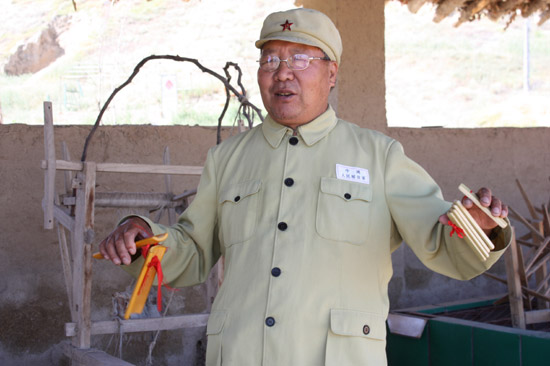
Hu Youcai,74,was a soldier doing reclaimation work with the Xinjiang Production and Construction Corps for 40 years. [Photo/China Daily] |
Shihezi, which now boasts a population of 320,000 with tidy streets and modern architecture surrounded by trees, was a settlement with only a dozen households when the pioneers arrived in far West China's Xinjiang Uygur autonomous region.
"I'm the last one from the company staying here. All my comrades-in-arms have left the place where we worked and lived together for nearly 40 years," said Hu Youcai.
The 74-year-old retired veteran arrived from Shandong province as a young soldier with the No 1 Army Reclamation Company of the Xinjiang Production and Construction Corps in 1950.
Now he gives tours of the one-time barren outpost, and gives lectures to students about the area's history.
"You won't see fascinating landscape here, or the hustle and bustle of a city," said Hu, standing beneath a gate carved as a wooden plough.
It's a symbol of the farm work the corps did to establish not only Shihezi but at least six cities in the region.
"As the one-time company commander, and also a participant and a witness, I feel I'm responsible to tell our stories to the next generation," the veteran said in front of a showroom where visitors can see a partially underground mud dwelling like those the soldiers lived in when they first arrived.
"It was cold and wet. And we used straw as mattresses," said Hu.
"More than 20 soldiers huddled into one nearly 10-sq-m hole. One summer night in 1950, it felt too crowded inside and so I went outside to sleep. After I woke up in the morning, I found four snakes asleep with me," Hu recalled.
There were 176 soldiers in Hu's company when they first settled in to begin their farm reclamation - all men and no women.
"Except for us, it was very difficult to find anyone else in that deserted land at all, let alone a woman to marry. So the army leaders invited women from Hunan and Sichuan provinces to come to Xinjiang and build families with us," Hu says.
But marriage created another problem - there were not enough mud huts for the newlyweds.
"I asked my soldiers to leave one mud hut free as a wedding room. They were allowed to stay in the room, decorated in red cloth, for at most a week because other new couples were waiting for it," he says.
Hu and his wife from Jiangsu province also spent their wedding night and their first three years after marriage in a mud hut before they moved in 1960 into a room that was less than 20 square meters.
Now the temporary wedding room has become a showroom, and for most visitors it is incredible to think of a space like this being sought after.
Before Hu begins speaking to visitors, he puts on his pale-washed yellow army uniform.
"When I put on the uniform, I feel I've gone back 50 years. I can tell stories to my visitors with solider-like passion," explains Hu.
"Soldiers got only one uniform a year," Hu says.
To save the uniform, soldiers usually stripped to the waist and worked barefooted in the farm carrying baskets of dirt, digging canals and leveling the land to grow cotton and crops.
"I cherish the old memories as my greatest treasure. But I always feel sad when I stay here," says the now-elderly man, "With my death nobody in this area will be able to recall those glorious days."
According to Hu, people who live around the place now are mostly migrant laborers from Henan, Anhui and Sichuan provinces.
"They know little about the history of the corps. They just work here for the money as crop-planters and cotton-growers," Hu sighs.
"But the spirit of the old generation - pioneering, hardworking and self-reliant - should be known by people."
Hu even started a blog last year and quickly became an Internet icon among visitors.
"I hope through the Internet and my telling of these true, moving stories, the corps and its valuable spirit could be known to more people," Hu says.