Economy
Current tax rate is too high, Chinese say
By Wang Xing (China Daily)
Updated: 2011-05-10 10:17
 |
Large Medium Small |
|
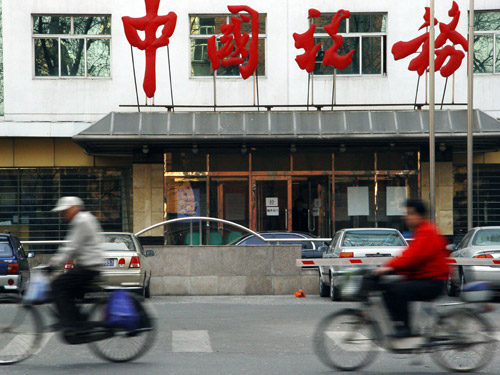 A tax office in Beijing. China's current individual tax rate is higher than that of many middle-and higher-income countries, according to a report by the Central University of Finance and Economics. [An Xin / For China Daily] |
BEIJING - China's recent proposals for the reform of the income tax system has prompted a nationwide debate about whether wage earners are paying too much to the government.
For most Chinese, the answer is an absolute "yes", according to a recent research by the Central University of Finance and Economics, a top financial college.
|
||||


The conclusion of the research was that the government should reduce tax rates while increasing input in crucial areas such as healthcare and education.
"In 2009, the average income for each person in China was only $3,700 and the current tax burden is too high," the report said. The research said that a country's tax burden should be in line with the level of its economic development.
According to a previous survey from the World Bank, the most suitable tax rate (the percentage of taxation revenue accounts in a country's overall GDP) for low-income countries (where the average annual personal income is below $260) should be 13 percent.
For middle-income countries, where average annual personal income is $2,000, the suggested tax rate is 23 percent. With an average personal income of $10,000 in high-income countries, the proposed tax rate is 30 percent. However, studies of China's tax burden revealed a lack of accuracy.
In August 2010, the Ministry of Finance told the media that China's tax rate was 24 percent in 2007, 24.7 percent in 2008 and 25.4 percent in 2009.
However, a report from the Chinese Academy of Social Sciences indicated conflicting data, showing that the tax rate was 31.5 percent in 2007, 30.9 percent in 2008 and 32.2 percent in 2009.
Since economic reforms in 1978, the government has gradually reduced subsidies in crucial areas such as healthcare, education and housing, where the Chinese population had previously enjoyed full coverage from the government under the planned economy.
However, the country has failed to establish an alternative system, including revision of the taxation system to protect the interests of the low-income groups.
Last month, the Chinese Cabinet proposed raising the annual personal income tax threshold from 2,000 yuan ($306) to 3,000 yuan, in a bid to boost domestic demand and reduce the burden on wage earners. The proposal is now open to suggestion from the public.
Commenting last week, Li Daokui, an adviser to the People's Bank of China, dismissed the proposal as "silly". He said the current tax system has failed as an instrument for effectively dealing with income disparity.
Jia Kang, head of the Research Institute for Fiscal Science, which is affiliated to the Ministry of Finance, said the amendment to the tax law is the government's response to growing public concern over inflation.
China Daily