Society
Reborn through rubbles, Qingchuan looks better
By Jiang Wei (chinadaily.com.cn)
Updated: 2011-05-03 18:03
 |
Large Medium Small |
One-armed Shi Guangwu and his deaf-mute wife lived a peaceful life in Zaoshu village, Qingchuan County in Southwest China's Sichuan Province. They ran a grocery store and tilled a plot of farmland while living in a two-story building with their son and daughter.
But on May 12, 2008, an 8.0-magnitude earthquake caught them by surprise, smashing everything they had.
Compared with some residents in Donghekou, another village in Qingchuan, Shi and his family were lucky. At least they didn't lose their lives. When the devastating earthquake stroke at 2:28 pm, more than 780 Donghekou villagers were buried alive by flying rocks and landslides. The deepest fell 110 meters.
The ruthless earthquake killed more than 4,600 people's lives in Qingchuan and injured more than 15,000. All of its 250,000 residents were affected and a lot were left homeless. Transportation, electricity, communication, water, natural gas and other infrastructure were paralyzed. Public service buildings like schools and hospitals were destroyed. The environment was greatly damaged due to 1,507 geological hazards, including cave-ins, landslides, cracks in the earth and twisted mountains. The already extremely poor county was thrown into a deeper plight.
Three years have passed.
What does Qingchuan look like now? Farmhouses have reappeared between the rolling mountains; new schools and hospitals were put into use; expressways and bridges have reopened. The county has used the rebuilding opportunity to improve its living standards.
|
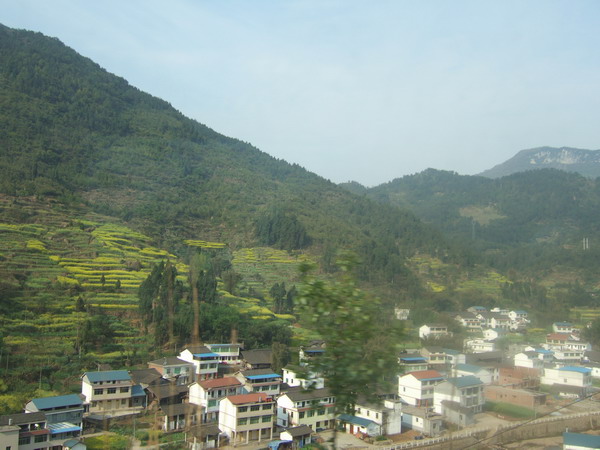 New farmhouses standing at the foot of the mountain in Qingchuan county, Guangyuan city of Southwest China's Sichuan province on April 16, 2011. [Photo/chinadaily.com.cn]
|
Donghekou village
Donghekou village, the most severely damaged site during the May 12 earthquake, is built into a park of earthquake relics for people to mourn the victims and learn about earthquake. In the 100-mu (nearly 6.7-hectare) park stand many big black crosses, signaling where the villagers were buried below. The crosses are special beams used in villagers' houses. People collected them from the destroyed houses and erected them to mourn the victims.
The earthquake destroyed 80% of the village's farmland and all of its industrial centers. Most of Donghekou's villagers have relocated to what they consider better places to live. For those who don't want to move out, the government rebuilt houses near the quake site.
As of Dec 2009, all of the 39 households have moved in new homes. They have access to water, electricity and telecommunication. The government provided a subsidy and equipped each household with a solar energy water heater and a biogas digester, which not only save people's living costs but are low-emission machines.
With little farmland, the villagers are encouraged to raise long haired rabbits, pigs and cows. The nearby earthquake park pushes forward the tourism industry. Some villagers changed their house to a home inn and provide localdishes for tourists. The reconstruction projects also provide many jobs. Considering the reconstruction is coming to an end, the government has tried its best to develop industry parks, so that local people can have a stable income. "The biggest change in the three years is the villagers' mindset," Wang Juncheng, a villager cadre, said. "People have walked out of the grief and regained the confidence to live. Now every one is thinking about how to earn money to live a better life."
Zaoshu village
The village where Shi Guangwu lives was destroyed. Houses either collapsed or were damaged. The electricity and telecommunication were cut out in the wake of the earthquake. After several days, when Shi had access to broadcasting, he learned how huge the disaster was. It had stricken a huge part of the country.
In July 2008, two months after the quake, Shi lead the village in the rebuilding of his house.
"I learned from the news that the disaster has affected a lot of people, so the government must be very busy and can't take care of everyone at the same time. I can't totally rely on and wait for the government to restart my life," Shi said.
Seeing his house rise brick-by-brick, other villagers began to rebuild their own houses. They villagers were inspired by the determination and progress of Shi and his wife despite the couple's physical challenges.
On the eve of the National Day (Oct 1) in 2008, Shi's family moved into their new house. As of June 2009, just one year after the earthquake, all the village's 206 households had moved into new homes.
Shi reopened his grocery store and bought a BYD car on loans to purchase goods for the store. Now he has paid off his loan. The car can earn him extra money if other villagers rent it for weddings or other events. He also got a grandson, who brings fun and new hope to the family.
The village now focuses on tourism development. Four farmhouse-turned-inns can receive 200 tourists per day. Tea gardens and orchards have bloomed within the village landscape.
Most of the reconstruction projects have finished, and all of them will be done in September, Sichuan officials said at a press conference in capital Chengdu on April 23.
Three years after a tragic and devastating earthquake, it seems Qingchuan may be months away from finally restoring - and improving upon - its former glory.