Society
Tsinghua aspires to become top university
(China Daily)
Updated: 2011-04-22 08:19
 |
Large Medium Small |
BEIJING - Tsinghua University, one of China's prime institutions of higher learning, will strive to be ranked on par with Harvard, Oxford and Cambridge as a major world university, officials and scholars say as the university celebrates its centennial anniversary this month.
|
 |
|
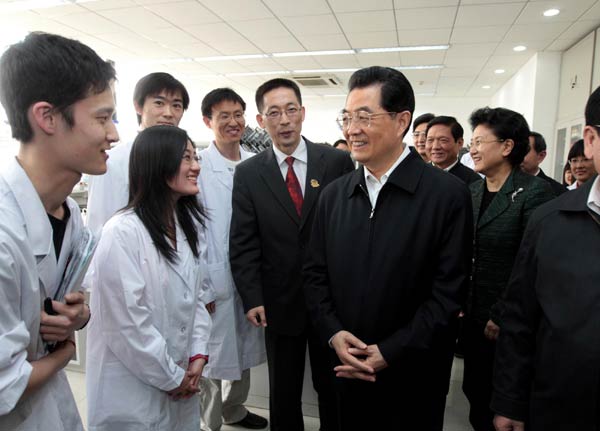
President Hu Jintao talks with students in a structural biology lab during his visit to Tsinghua University on Wednesday. [Photo/Xinhua] |
Tsinghua, founded in 1911 originally as a training school for students aiming to study abroad, became known as the "cradle of Red elites" - training tens of thousands of capable politically-minded graduates in the course of building new China after 1949.
Tsinghua also produces more senior officials than any other Chinese universities. Alumni include President Hu Jintao, top legislator Wu Bangguo, Vice-President Xi Jinping, and former premier Zhu Rongji.
During his visit to Tsinghua on Wednesday, Hu made a stop at the department of hydraulic engineering and chatted with his former classmates, who are now university professors.
Hu, who studied and worked at Tsinghua for nine years in the 1960s, urged the university to mark the centennial as a new start in its attempt to achieve major world university status and to train more graduates for the purpose of boosting China's prosperity.
Tsinghua President Gu Binglin said the university plans to make changes in some of its departments to put them on par with the world's top institutions and raise its overall education quality to a significantly higher level.
Tsinghua was ranked 35th in this year's Times Higher Education world university ranking. It was rated as the top Chinese university, followed by Peking University, which ranked 43rd. Harvard University topped the ranking.
Gu said Tsinghua began to eye a higher global ranking in 1985, and such a goal received a major boost in 1998, when the central government increased funding for nine Chinese universities, including Tsinghua.
Tsinghua now employs Nobel Prize-winning physicist C.N. Yang, Turing Award-winning computer scientist Andrew Chi-chih Yao and other academic masters as full-time teachers.
The university's international exchanges have also improved over the years. More than 30 percent of Tsinghua's undergraduates and 40 percent of its graduate school students have spent time studying and researching abroad, Gu said, while 2,000 foreign students are studying at Tsinghua.
| ||||


"It isn't just Tsinghua. The past decade was a golden era for many Chinese universities," said Xiong Bingqi, deputy director of the 21st Century Education Research Institute. "They received larger amounts of funding from the government and made more academic progress."
The central government promised to increase spending on education to 4 percent of GDP in 2012. However, the amount of additional funding that universities like Tsinghua will receive is still unknown.
Premier Wen Jiabao said earlier this year during an online chat with netizens that "China's rise lies in talent and education."
China has aggressively expanded higher education enrollment numbers over the past decade. The number of students on campuses across the country has quadrupled since 1998 to reach 28 million.
However, Xiong said becoming a top-rated global university is still a far stretch for Chinese universities.
"Sadly, we found that the quality of our graduates is declining," Xiong said. "This consensus has already been reached by employers, teachers and even the students themselves."
Xiong said that one sign that top Chinese universities are losing out to their peers abroad is that an increasing number of Chinese high school students have opted to go abroad for higher education in recent years.
Xiong said the dominance of administrative or government power in university affairs and relative lack of academic freedom are to blame.
He said Chinese universities need to break free from campus bureaucracy and champion academic research as their core value before they can truly become competitive with leading foreign universities.
Xinhua