Society
Radioactive water to pose little danger to China
By Li Yao (China Daily)
Updated: 2011-04-06 07:33
 |
Large Medium Small |
BEIJING - Chinese authorities said on Tuesday that the country is under no immediate threat from the radioactive pollution that will result from Japan's plan to release 11,500 tons of radioactive water into the sea.
|
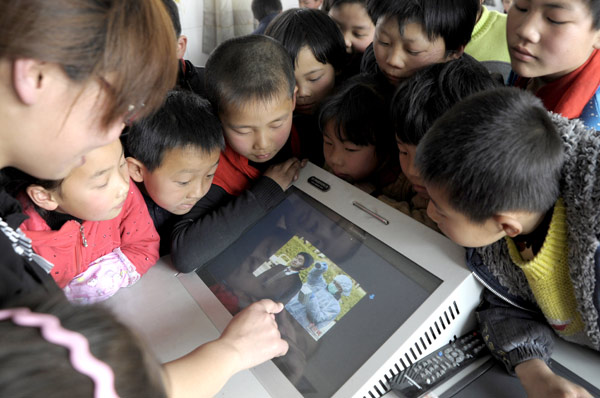 A teacher at the Tangxi Primary School in Dongyang city, East China's Zhejiang province, on Friday uses a computer to show her students how to protect themselves from radiation. [Bao Kangxuan / for China Daily] |
On Monday, Tokyo Electric Power announced a plan to pour radioactive water from the Fukushima Daiichi nuclear power plant -- which has been leaking radiation since being inundated by a tsunami last month -- into the Pacific Ocean. The step is being taken to ensure the storage space at the plant can be used to contain more contaminated water.
Yu Fujiang, deputy director of the National Marine Environmental Forecasting Center of the State Oceanic Administration, said radioactive materials have so far come to China only through the air currents, not by sea.


He said China's National Nuclear Emergency Coordination Committee has remained vigilant of Japan's nuclear emergency, carefully monitored radiation levels throughout China and provided the public with timely information about its findings.
Zhu Hanmin, a researcher on radiation protection and nuclear safety at the Chinese Center for Disease Control and Prevention, also said Japan's decision to release the radioactive water will not immediately affect Chinese waters. He explained that the radiation level of the discharged water is low and that ocean currents will take the water eastward, away from China.
By the time the radiation reaches China, it will be diluted. Zhu said he expects little danger to come from iodine-131 -- which has a radioactive half-life of about eight days -- and similar elements that will be present in small amounts.
Yet, Yoichi Enokida, a professor of materials science at Nagoya University's graduate school of engineering, was quoted by the Associated Press as noting that the released water doesn't contain iodine alone. It also contains cesium-137, which has a much longer half-life.
Both substances can build up in the flesh of fish, although iodine's short half-life means it won't stay there very long. As for cesium, its likely long-term effects cannot be known without more research.
"It is extremely important to adopt a plan to reduce the outflow of contaminated water as soon as possible," he said.
The nuclear emergency led the Japanese government on Tuesday to create an acceptable radiation standard for fish for the first time, according to the Associated Press report. Some fish caught on Friday off Japan's coastal waters would have exceeded the new provisional limit had the limit been in place then.
Qiu Yongsong, a researcher at the South China Sea Fisheries Research Institute, said radiation testing should be conducted more strictly on the next fish harvest from Japan's Hokkaido fishing areas in the northwest Pacific Ocean. Seafood products, she explained, may pose more of a danger as radioactive substances become more and more concentrated in marine animals, the Beijing-based Mirror newspaper reported on Monday.
Japanese seafood importers, meanwhile, are likely to suffer some of the worst hardships stemming from the emergency, insiders said.
Yu Jun, manager of a Shanghai company that supplies Japanese food ingredients, said business had already taken a dive following the earthquake that struck Japan last month. And he expects that more customers will be scared away by the country's decision to dump contaminated water into the ocean.
Since April 2, after reports had appeared saying contaminated water was leaking from the Japanese nuclear plant, many micro-bloggers on sina.com.cn have posted entries warning of dangers posed by seafood products.
Earlier reports said many supermarkets and restaurants in China had decided to avoid using Japanese food products in response to customers' concerns about radiation.