Society
Sweep, pray and eat qingtuan
By Shi Yingying (China Daily)
Updated: 2011-04-05 07:39
 |
Large Medium Small |
 |
|
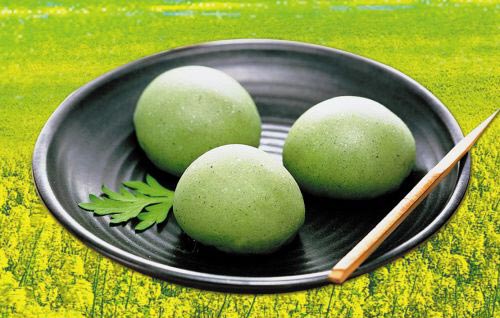
Qingtuan is a popular snack in the Yangtze River delta areas. [China Daily] |
Shanghai
During the Qingming Festival, or Tomb Sweeping Day, we sweep, pray - and eat qingtuan.
Qingtuan, a small, green, jade-like rice dumpling, marks the beginning of Shanghai's spring, or at least makes a difference between eating outside and inside Qiaojiashan - one of the city's oldest local restaurants famous for its snacks.
Outside the restaurants, lines of Shanghainese young and old form the happy crowds waiting in front of the takeaway spots for their favorite April dessert, while inside Qiaojiashan, it is cold and quiet with only a few diners milling about on a regular weekday afternoon. Thanks to the magic of the sticky-rice red-bean-filling pastry, Qiaojiashan saw record sales for the year - 1,000 qingtuan sold a day.
"At least 1,000 qingtuan are sold every day between the week before Tomb Sweeping Day and a week after," says Zhang Dagang, Qiaojiashan's pastry chef. "For most of the seniors, it's a must at ancestral rituals when they make offerings of food at the family tombs, while for the children, it's a sweet treat."
Zhang remembers making the round-shaped dumplings when he was a child, "but that was about 50 years ago and young people today no longer know how to make it".
According to him, "qing", or green, comes from the green grass extract in which the dumpling is soaked for a long time. It coincides with the first word of the Qingming Festival and with the color of green - the symbol for spring.
"Qingtuan should not be sweet - we mix the juice of wheat straw or wormwood with sticky rice to make it - my first bite of qingtuan was actually salty," Zhang says. His restaurant now provides a wide variety of qingtuan flavors like red-bean, rose-petal and sesame.
"Nowadays we no longer hand-mix the grass extract with rice on the spot, instead, we use green sticky rice premix," Zhang says.
Qingtuan is always accompanied by the fresh scent of spring before or after its 13-minute steaming process. It always appears on time on shelves in Shanghai and other regions in the lower reaches of the Yangtze River, much like the spring morning heralding the new year.
The most well-known qingtuan are those made in Suzhou's Zhengyi town and are now available in Shanghai. To make Zhengyi qingtuan, a special type of weed called wheat straw is needed. It must be washed before being soaked in a basin of lime. Take the weed out and pound it until it becomes pulp, then squeeze the green extract out. Zhengyi's qingtuan is famous for retaining its exact shape and color after seven days of storage, whereas other qingtuan usually have a shelf life of between three to five days.
When wheat straw is not available, wormwood leaves can also be used. The grass is considered an important ingredient in traditional Chinese medicine. It can "cool the blood and clear the heat".
In some regions of Jiangsu province, chopped grass is also mixed in to bring an extra flavor of spring.