Society
Untended tombs
By Chitralekha Basu (China Daily)
Updated: 2011-04-05 07:40
 |
Large Medium Small |
|
The Eastern Qing Tombs, 128 km north of downtown Beijing in Hebei province, is one of the least known complexes of its kind. Chitralekha Basu / China Daily |
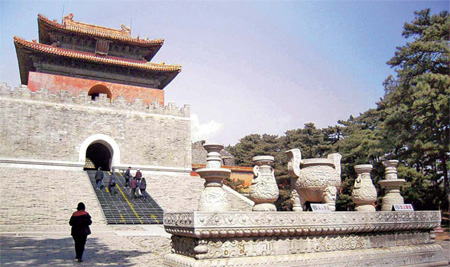
Speaking of tomb sweeping, here's something interesting off the beaten trek. Chitralekha Basu reports.
It's probably one of the least visited mausoleum complexes in the Beijing area. And, when I visited the Eastern Qing Tombs on the first warm weekend of 2011, about a week before the tomb-sweeping festival, the grand array looked almost forlorn.
So alone, in fact, that I might have been locked inside the tomb of the Kangxi emperor (1662-1742), and not even known it until it was distressfully late. I didn't realize that Kangxi's tomb was off-limits to visitors. After all, there weren't too many of them milling about the complex with its memorials dedicated to five emperors, 15 empresses, 136 imperial concubines, three princes, and two princesses of the Qing Dynasty (1644-1911), anyway.
I entered through a door that was half ajar and climbed up on the mound trying to see whether there was a way into the burial chamber. But, unlike some of the other tombs, this one seemed sealed from all sides.
After a while, a man came running over from a backyard, a trowel in hand, asking me to get down immediately. I did as he asked and he briskly set to scraping away the weeds and hollyhocks growing between the bricks on the mound. He then darted out the heavy metal door with brass knobs and locked it behind him, leaving Kangxi, China's longest-reigning Emperor in history - to rest in peace.
The rulers of the Qing - the last imperial dynasty in China - chose to put the family cemetery 128 km north of downtown Beijing. It lies in Hebei province on a flat, 80-sq-km patch of ground, locked in by hills on all sides.
As royalty, they probably weren't expecting any visitors, except some kinsmen and it's still not high on the regular tourist must-see list. It's a bit too far out of town, compared to the more accessible, if less dramatic, Ming Tombs in the Changping district in Beijing.
As a result this largest of the imperial burial ground complexes in China has seen relatively less wear and tear, and hence is also the least-restored.
A lot of China's imperial architecture looks as if the red and gold paint were applied just yesterday. But here the wooden beams of the Dowager Empress Cixi's memorial have, evidently, not been touched up in a while. The dragons and floral patterns etched in gold appear in sharp relief against the fading paint on the wooden beams holding the ceiling. If you like your history to look credibly old, this place will charm you.
The Eastern Qing Tombs' layout is about as theatrical as it can get. It fans out against a majestic backdrop of the Changrui Mountains, with the memorials, dedicated to kings, princes and concubines, standing like actors on a stage, each with its own history and character.
Each unit was built along the lines of a traditional courtyard house, complete with a hall, tomb, and garden, often dotted with steles.
A wide marble-lined road connects the gate with five arches on the southern boundary of the complex to the tomb of the Xiaoling emperor, the first of the Qing (1644-1661), which forms the centerpiece of this elaborate theatrical commemorative array.
The 6-km approach (called the spirit way), which seems to emerge from under Tiantai Mountain in the south, slices through the entire tomb complex in perfect symmetry. It's punctuated by a line of huge marble sculptures of sentries, mandarins, armed-warriors, saddled-horses, and elephants with elaborate ornamental seats on their backs, all standing at attention. The feel is one of serenity and battle-readiness.
It's a bit ambitious to try to see all nine tombs at one go, even if you have a car to ferry you about. Xiaoling's mausoleum is easily the grandest, since it includes a huge garden of steles and intricately-carved marble bridges over a canal at its approach.
The Qianlong emperor's (1735-1796) vault stands out because of the marble carvings on its walls, featuring Tibetan-Buddhist motifs and calligraphy.
Empress Cixi's memorial hall attracts visitors because it's a relic of the dowager empress' love of opulence, power and a bit of whimsy. Her personal effects on display include multiple snuffboxes and bejeweled back-scratchers.
My personal favorite is the Garden of Rest, an enclosure dedicated to the Qianlong emperor's 35 concubines, including a significantly bigger tomb for the "fragrant concubine", Xiang Fei, a Uygur, who has inspired novels like The Book and the Sword, by Jin Yong (Louis Cha). The rest are buried under round knobs of brick on which weeds grow in this untended garden.