Society
Fitting monument for an enduring plum blossom
By Yang Guang (China Daily)
Updated: 2011-04-05 07:40
 |
Large Medium Small |
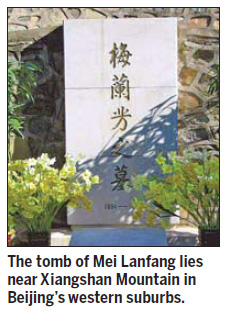
The marble tombstone with the plum blossom design clearly identifies the person buried here, whose surname, Mei, is the Chinese word for plum, whose flower symbolizes elegance and fortitude.
The tomb is for Mei Lanfang (1894-1961), a master of Peking Opera, along with his two wives and other family members.
He lies resting halfway up Wanhua Hill, near Xiangshan Mountain, in Beijing's western suburbs, surrounded by a pine grove. The trees were planted in accordance with his wishes, and can occasionally be heard whispering in the soft early spring breeze.
The plum blossom motif can be seen everywhere, and the flower does perhaps describe Mei's character. Yan Geling, the scriptwriter of the 2008 biographical film Forever Enthralled, directed by Chen Kaige, refers to Mei as a "soft resister of his times".
Mei was born into a family of Peking Opera and Kunqu performers. He made his debut at the age of 10, and over the course of his more than half-a-century stage career, he absorbed the essence of the art's traditions, constantly adapting them to keep abreast of the times.
He is particularly noted for his interpretations of Liu Yingchun, in The Fen River Bend, Consort Yang Yuhuan, in The Drunken Concubine, and Consort Yu, in Farewell My Concubine.
Mei was known for his dan (female character) roles, and is paramount among the four great dan performers (the others being Shang Xiaoyun, Cheng Yanqiu and Xun Huisheng), of Peking Opera's golden era. As such, he developed his own style, which is recognized as the "Mei Lanfang School".
He was, in fact, the first person to introduce Peking Opera to the world, through tours to Japan (1919, 1924 and 1956), the United States (1930), and the Soviet Union (1935 and 1952).
Mei was indeed a resister; his adaptations of the traditions were once criticized and his efforts to make high-class artists out of humble people were thought contemptible. In those circumstances, he could not be as soft as the tender female roles he played - there had to be a strong force inside to keep pushing him forward and letting him hold on.
During the War of Resistance Against Japanese Aggression (1937-1945), a Japanese army commander ordered Mei to perform for him and gave him a high-ranking position. But Mei refused, grew a moustache, and endured frugally until the end of the war.
For this reason, Mei has been hailed as a great patriot. Nonetheless, some lines from his autobiography, Forty Years of Life on Stage, reveal a more delicately nuanced personality: "For an actor of my age, what a great loss that eight-year gap was. It is a loss that can never be compensated. In that long period of time, I was dead at heart. I grew a moustache, clenched my teeth, and led a quiet, boring life. The mere thought of it reminds me of how the war debilitated me."
Mei chose the cemetery location himself. One curious reason was that Wanhua, the name of the hill, happens to be a homophone of his style name, or zi (also known as a courtesy name, given after the age of 20 as a symbol of adulthood).
Another curious thing is that the hill sits opposite "Mei boulder", on Xiangshan Mountain, a place he used to frequent in his youth.
In the spring of 1922, Mei traveled to Toad Peak on Xiangshan Mountain, with several friends. Most of the boulders bore inscriptions from the Qianlong emperor of the Qing Dynasty. Mei found one hard boulder and whimsically wrote a 1.95-meter-tall, 1.9-meter-wide "mei" character. That boulder is now a scenic spot that attracts many tourists, especially in late autumn, when the maple leaves are a crimson-gold.
After Mei's death, other elderly members of the Peking Opera decided to be buried in a similar setting, such as the actor Ma Lianliang, accompanist Xu Lanwan, and actor and opera teacher Wang Shaolou. It seems that artists still want to gather in the company of their own kind in the afterlife - perhaps in a performance of everlasting sorrow and loss.
China Daily
(China Daily 04/05/2011 page10)