Government and Policy
Medical reform challenges remain
By Shan Juan (China Daily)
Updated: 2011-03-04 08:29
 |
Large Medium Small |
BEIJING - More than a year after the latest phase of China's ongoing medical reforms started, the nation's top health official conceded many uncertainties remain about how best to improve public hospitals.
Minister of Health Chen Zhu made the remarks on Thursday from the sidelines of the Fourth Session of the 11th National Committee of the Chinese People's Political Consultative Conference (CPPCC).
"Now, it still remains a tough question; how to operate public hospitals in our country," said Chen, who is a CPPCC member with no party affiliation. "Given that health administrations at both the central and local levels are actively groping for a way that might work, I am confident that we can finally figure it out."
He added that medical reform is a common challenge facing all countries. Worldwide, every government is struggling with the problem of lowering overall health expenditure while trying to provide universal healthcare to citizens.


"The government needs to figure out a sustainable funding mechanism that will not hurt the interests of stakeholders," she said.
In 2009, the central government unveiled a three-year plan costing 850 billion yuan ($130 billion) for medical reforms, including the setting up of multi-layered health insurance policies to cover as many people as possible and carrying out the reform of public hospitals. The aim of the plan was to offer universal and affordable medical services to all people in the country.
Other than the thorny issue of public hospital reform, "it's also a worry that the capacity of grassroots-level hospitals is quite limited," Chen noted, citing historical reasons. For instance, 8,000 county-level hospitals still cannot carry out dialysis, a treatment necessary for uremia patients, he said.
Chen also revealed that the treatment of severe conditions, including uremia, breast cancer and cervical cancer, will soon be covered by the health policy under selected pilot schemes.
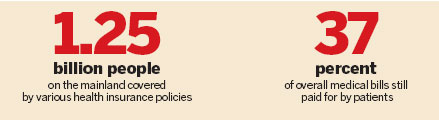
By the end of 2010, more than 1.25 billion people on the mainland were covered by various health insurance policies, according to statistics from the Ministry of Human Resources and Social Security. But Health Ministry figures reveal that people still had to pay 37 percent of their overall medical bills last year.
Regarding the food safety issue, he said the central government was highly concerned and working hard to protect people from problematic food.
In five years, a network of food-borne disease surveillance will be set up to help facilitate better knowledge of and quicker response to food safety problems, he said.
"It's also part of the plan to integrate the task of securing food safety into the country's major public health projects, now including immunization and major disease prevention," he added.