Society
Malnutrition hits poor children
By Cheng Yingqi (China Daily)
Updated: 2011-03-01 07:41
 |
Large Medium Small |
Nutrient lack common in impoverished populations
 |
|
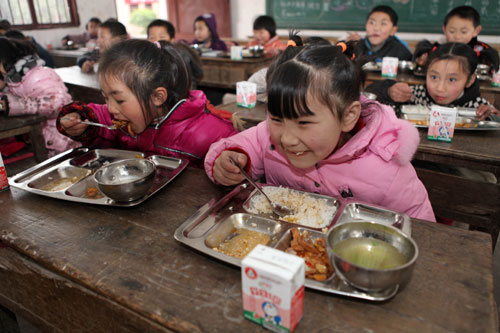
Pupils at a primary school in Chongqing's Dazu county eat free lunches on Feb 16. To better ensure the nutrition of local children, the county launched a 10-million yuan program to offer free lunches to 6,000 children from poverty-stricken families or those left behind while their parents work in cities. Provided to China Daily |
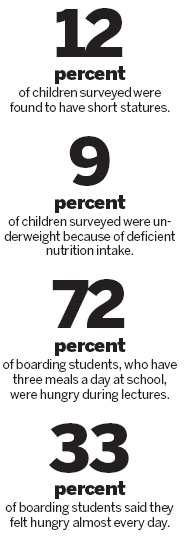
BEIJING - Malnutrition is affecting 12 percent of children in poverty-stricken areas in China's less-developed provinces and regions, recent research shows.
The China Development Research Foundation released a survey on Sunday of 1,458 children aged 10 to 13 in Qinghai, Yunnan, Ningxia and Guangxi.


Moreover, 72 percent of boarding students, who have three meals a day at school, were hungry during lectures, and 33 percent of them said they felt hungry almost every day.
"In some regions in Yunnan province, the daily meals of the children are simply soybeans and rice. Many pass out when they are doing morning exercises," said Lu Mai, secretary-general of the foundation.
According to the survey, the daily caloric intake of students from the Ningxia Hui autonomous region is only 62 percent of the recommended level. The figure is 66 percent in Guangxi Zhuang autonomous region and 68 percent in Yunnan.
Similarly, in the provinces and autonomous regions polled, the students' microelement consumption is 20 percent lower than recommended.
"Short stature, low weight and inadequate intake of certain nutrients are all called malnutrition. For school-age children, who are at their prime to develop a good physique and brains, malnutrition is a hard blow," said Ma Guansheng, director of the Institute for Nutrition and Food Safety under the Chinese Center for Disease Control and Prevention.
"For example, iron is essential for enhancing memory. If the students have attention problems, it tends to be the result of eating too little iron, not that they are naughty," Ma said.
When China eliminated the agricultural tax several years ago, the revenue of local governments was reduced and they could not afford to feed children boarding at schools. So the central government moved the compulsory nine-year education fund in rural areas into its public finance, which included a subsidy to poor boarding students.
But the number of students helped by the policy is "relatively low" compared with other countries that adopted similar policies, said Lu from the foundation.
In 2010, the Chinese government spent more than 10 billion yuan ($1.5 billion) helping 12.25 million poor students get a better diet. Meanwhile, 30 million in Brazil benefited from a similar policy, while 120 million did so in India.
To make things worse, some public schools spent money from the fund - 2 yuan per day per person for primary school students - on hiring cooks instead of providing better food. Others split the money among all students - both boarding students and day students.
"Day students are no better than boarding students in terms of their health, so the subsidy should cover both of them," Lu said.
Chen Chunming, a professor and a retired official of the Ministry of Health, said that it was "still not enough to solve the problem if the government simply grants more funds".
"The cost varies in different provinces in line with diverse food prices. So the more efficient way is to support children directly with food, instead of a fixed amount of money."
Chen suggested that the government publish a nutrition intake standard for public schools to follow.
She said every student should be given two meals a day, which would ensure they get a sufficient intake of eggs, fresh vegetables, soybeans and meat.