Government and Policy
Premier sets 7% growth target
By Hu Yuanyuan (China Daily)
Updated: 2011-02-28 06:47
 |
Large Medium Small |
Environment 'must not be sacrificed for rapid development'
 |
|
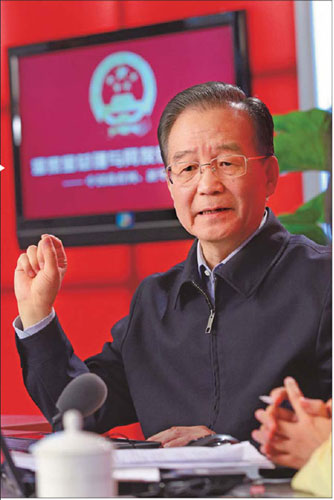
Premier Wen Jiabao chats with netizens at xinhua.net.cn on Sunday. It is the third consecutive year that the premier has conducted an online talk prior to the annual sessions of the top legislature and advisory body, scheduled for early March. Pang Xinglei / Xinhua |
BEIJING - An annual growth target of 7 percent over the 12th Five-Year Plan (2011-2015) has been set to ensure sustainable development, Premier Wen Jiabao said on Sunday.
"We must not any longer sacrifice the environment for the sake of rapid growth and reckless roll-outs, as that would result in unsustainable growth featuring industrial overcapacity and intensive resource consumption," Wen said during an online chat with Internet users.
The target was lower than the 7.5 percent set for the previous five years, when the country's economy actually grew at an annual rate of around 10 percent from 2006 to 2010.
| ||||


Increased efforts will be made to improve people's living standards, and the government will adopt new performance evaluations for local governments to hasten economic restructuring.
The criterion for assessing their performance is "whether the public are happy or not ... but not by how many high-rise buildings and projects he had been involved in," Wen said.
He also promised to strengthen efforts to contain increases in prices of food and other commodities, which have stoked inflation. Maintaining price stability has always been a priority as "rapid price rises have affected people's lives and even social stability", he said, adding adequate grain supplies and abundant foreign exchange reserves would help curb inflation.
The consumer price index (CPI), a main gauge of inflation, rose 4.9 percent in January from a year earlier as food prices increased 10.3 percent due to rising demand and a drought in key grain-growing regions. Food accounts for one third of the CPI basket. The CPI increased 4.6 percent in December and 5.1 percent in November, a 28-month high.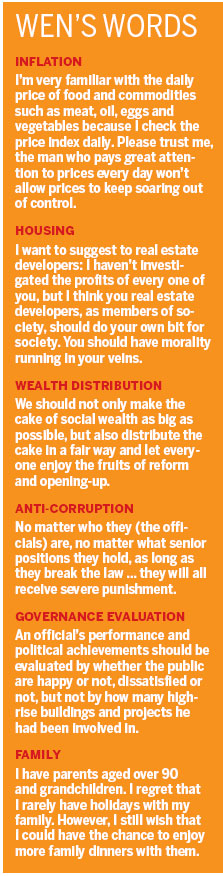
The government has taken a slew of measures to keep prices under control, including increasing grain output and boosting drought relief. To mop up excess liquidity, the central bank has lifted the reserve requirement ratio (the minimum reserve banks must hold) for commercial banks eight times since the start of last year, and hiked interest rates three times since mid-October.
"With these measures better implemented, we definitely can contain inflation," Wen said.
Liu Shucheng, a member of the Chinese Academy of Social Sciences, said that the country's CPI will peak in the second half of this year, rather than the first half.
"The international price of crude oil may rise further. Considering the soaring grain price in the international markets and quantitative easing by the US, China's CPI will probably exceed 5 percent this year," Liu said.
The government set the CPI target at 4 percent this year, a goal most analysts said will be hard to achieve.
According to the China Quarterly Macroeconomic Model, a study jointly conducted by Xiamen University and the National University of Singapore, China's CPI will hit 5.4 percent in 2011, 2.07 percentage points more than last year. The study predicted it will ease to 4.55 percent in 2012.
"Currently, the CPI is still mainly driven by domestic factors. But imported inflation will gradually play a bigger role in pushing up the index as the international price of crude oil and agricultural products soar," said Chen Kang, professor at the Lee Kuan Yew School of Public Policy under the National University of Singapore.
Yi Gang, vice-governor of the central bank and head of the State Administration of Foreign Exchange, said at a forum on Saturday that the country's large trade surplus is the source of inflation.
"At the end of 2010, China's foreign exchange reserves stood at $2.85 trillion, thus the central bank had to roll out nearly 20 trillion yuan ($3.04 trillion) to keep the exchange rate stable. Too much money in the market fuels inflation and pushes up prices," Yi said.
For Li Wenpu, director of the Center for Macroeconomic Research at Xiamen University, changing the trade structure is an important element in reducing imported inflation.
"If the amount of processing trade (where raw materials are imported and the finished product exported) gradually falls, we will not be so vulnerable to imported inflation," Li said.