Society
Discovery rekindles legend of 'blood-sweating' horse
(China Daily)
Updated: 2011-02-22 07:49
 |
Large Medium Small |
|
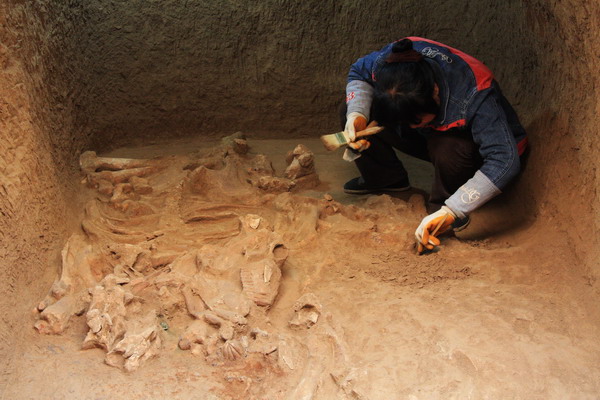 A woman cleans soil from horse skeletons in a sacrificial pit inside the mausoleum in this file photo. [Photo/Xinhua]
|
|
||||


Yang and his team began excavating the two pits in September 2009, but had published few of their findings until Monday.
|
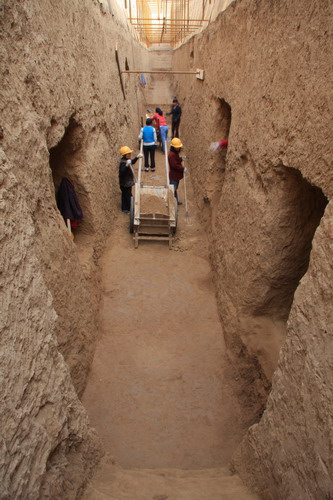 Workers ship out dirt from the sacrificial pit in this file photo. [Photo/Xinhua]
|
Each of the two pits was a huge cavern containing 20 caves - each "guarded" by two stallions and a terracotta warrior, Yang said.
He said archaeologists have conducted laboratory work on the skeletons and confirmed all were adult male horses. "Scientists will soon carry out DNA tests hoping to determine the genus of the horses."
The finding was likely to rekindle a centuries-old Chinese legend about the mysterious blood-sweating horse from Central Asia, Yang said.
"The legend goes that Emperor Wudi offered a hefty reward for anyone who could find him a mysterious 'blood-sweating' purebred horse that was said to have roamed Central Asia, but was rarely seen in China," he said.
Today, the horse is identified as the Akhal-Teke, one of the world's oldest and most unique breeds.
Wudi left China's earliest written record of the breed, in a poem he composed for his Akhal-Teke mount, describing it as a "heavenly horse".
The horse is known for its speed, endurance and perspiration of a blood-like fluid as it gallops along. It was also believed to be the horse ridden by Genghis Khan (1167-1227).
Wudi was best known for his opening of the Silk Road, an ancient trade route linking Asia and Europe.
Construction of his mausoleum began in 139 BC, a year after he was enthroned at 16 years of age. It took 53 years to build.
The mausoleum had more than 400 sacrificial pits, more than the mausoleum of the "first emperor" of a united China, Qin Shihuang.