Society
Urban China: Playground for the rich?
(Xinhua)
Updated: 2011-02-22 06:24
 |
Large Medium Small |
 |
|
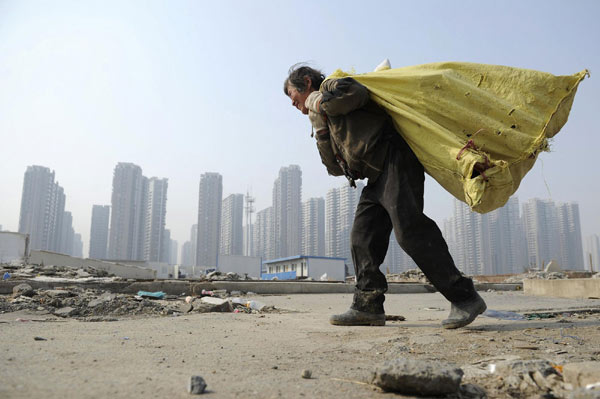
A rubbish collector carries a bag on her back as she walks past a construction site near a recently finished residential complex in Hefei, Anhui province February 21, 2011. [Photo/Agencies]
|


A haircut cost 50 yuan (7.6 US dollars) while a bath goes for 100 yuan. Xue wonders where to find the small barbershops and bathhouses that he often visited not far from home.
Civilians and experts warned many Chinese cities against being obsessed with boosting high-end public services, as ordinary people wait in long queues to see a doctor or lose open spaces for exercise.
According to Xue, the family would have to pay 4,000 to 5,000 yuan a month for his grandson to study at a bilingual kindergarten. He added that a "decent but low-cost" kindergarten is very hard to find.
Figures from the Beijing Municipal Bureau of Statistics show that the average annual income per capita in Beijing's urban areas last year was 29,073 yuan, or 2,400 yuan per month.
Now Xue's family is beginning to worry about their child's elementary school education.
According to Xu Guangjian, vice dean of the public management college of the China Renmin University, it is reasonable to have privately-owned education and health services that cater to high-end consumers. However, public services set up by the government should refrain from offering such provisions and strive for equality for all consumers.
"Urban public services should be open, fair and equal, and provide specific service products in accordance with the demands of different people," Xu told Monday's People's Daily.
Experts attributed the growing trend of luxury urban construction to the desire for profits and a decent GDP figure.
According to Luo Yameng, head of the China City International Association, local governments can achieve considerable profits by developing land through fast and large-scale construction projects.
Besides profits, a decent urban image cultivated by skyscrapers and luxurious products is always a shortcut for city officials to showcase their achievements, Luo said. He added that an urban image competition among Chinese cities is very common.
Li Jingwen, an academician with the Chinese Academy of Engineering, called for the inclusion of more common people in the decision-making process for urban construction.
Li cited a feedback system that was adopted by many cities to solicit ideas from residents on urban planning and development.
Meanwhile, Luo Yameng stressed that residents will inevitably be divided into different classes as a city develops, but the majority will still be on an equal level.
"The ultimate goal of urbanization should be people-oriented. Everybody should have the chance to enjoy the fruits of urbanization -- not just the rich ones," Luo added.