Economy
Price-rise disease plagues herbal medicines
By Shan Juan and Cang Wei (China Daily)
Updated: 2011-01-04 08:40
 |
Large Medium Small |
BEIJING - The prices of most herbs used in traditional Chinese medicine on the mainland have risen continuously in 2010.
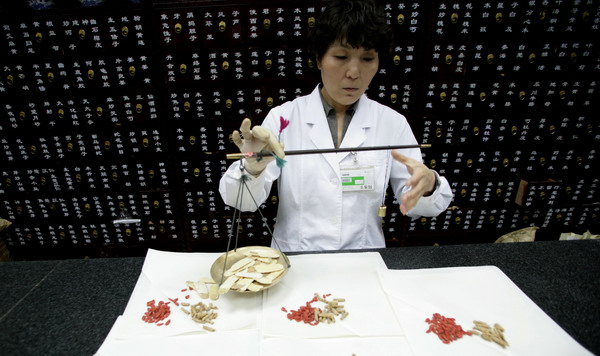 A pharmacist measures traditional Chinese herbal medicine at Tongrentang Pharmacy in Beijing in this file photo. [Photo/Chinadaily] |
| ||||


For instance, customers may now find that jinyinhua, or Japanese honeysuckle, which is used to treat colds, costs four times more than a year ago.
The price of another herbal medicine, taizishen, or false starwort, commonly used to tone the body, has dramatically risen from 53 yuan ($8) a kilogram to 240 yuan.
Some retailers and clinics have already stopped selling those medicines with soaring prices and have attributed the price surge to supply shortages, which are partly caused by the reduction of herbal plantations.
Due to rising crop prices, many peasants have cut down swathes of herbal plantations and switched to crop plants. As growing areas shrink, the price of herbs increases, chinanews.com reported on Sunday, citing Jia Haibin, deputy director of the information center at the association.
Total production of herbs has dropped by 20 percent since 2000.
The market has also witnessed a sharp drop in the supply of wild herbs, which has made the supply shortages of herbal medicines even greater.
Apart from supply shortages and growing market demand, inflation has also contributed to the price rises, Jia said.
"It was natural to raise prices of herbal medicines following the nationwide spike in commodity prices," said Li Zhigang, deputy director of the School of Acupuncture at Beijing University of Chinese Medicine. "However, the burden falls on ordinary customers, especially regular ones."
Because manufacturers of Chinese patent medicines have to pay more to purchase herbs, the prices of these medicines have also increased.
Since more people have speculated in herbs in anticipation of further price rises, the supervision authorities should keep an eye on traders who hoard herbs to make a profit, Jia said in the report.
Besides, more effective measures should be taken to keep herbs affordable for the public, he said.
?