The earliest days of international expositions stressed concepts such as trade and progress, but in recent decades, they've become more and more focused on environmentalism: not just educating the public, but exploring what might be done to undo the damage and experimenting with new ideas and forms to reduce society's impact on the planet.
An unlikely place ushered in the first World's Fair focused on environmental issues: the small town of Spokane in the US state of Washington. It hosted the 1974 Expo on the Spokane River with the theme, "Celebrating Our Fresh New Environment". At the time, environmental awareness was just beginning and issues were mostly limited to local ones.
The state of our planet's water has been explored in many subsequent expositions. Okinawa's Expo in 1975 and Lisbon's Expo in 1998 focused on our oceans and New Orleans' 1984 Louisiana World Exposition looked at our rivers. The most recent world's fair, Expo in Zaragoza, Spain hosted The Water Tribune, a forum for experts and citizens to address worldwide issues related to water that resulted in The Zaragoza Charter, a document that summarized the conclusions of thousands of experts during the 2008 Expo's hundreds of lectures.
It's been observed in recent years that building dozens of temporary structures presents a seeming contradiction when simultaneously trying to promote sustainable development. Different pavilions have addressed this in different ways. Many Expo structures now make use of recycled or renewable materials while many structures are simply re-used for other purposes after closing day. Other concepts have also been explored.
When Hannover, Germany hosted the 2000 Expo under the theme "Man, Nature, Technology," Switzerland built a pavilion almost entirely of wooden beams held together by tension using steel rods. When the Expo ended, nearly the entire pavilion became a lumber yard providing undamaged wooden beams for new construction.
Japan's pavilion at that exposition used a recyclable paper tube structure supporting a membrane. Typically, PVC is used in such membranes, but that material emits dioxins when burned. Instead, the Japanese used a water-resistant, fire-retardant paper roofing for the membrane. This technology was developed in Japan and was so groundbreaking, it needed special approval by German authorities before it could be occupied.
When it came for Japan to host its own World Expo, it did so under the theme "Nature's Wisdom". Held outside Nagoya in 2005, it continued to showcase environmental design through innovative energy-efficient transportation methods and a site that was designed to leave a small footprint on existing parkland - literally.
The Expo Loop, an elevated walkway that connected the various pavilion clusters, was designed with fan-like support columns that disturbed the park's ground in fewer places than a conventional walkway design.
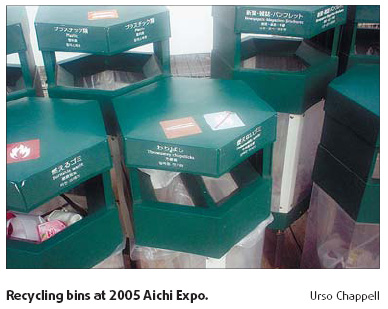
Great care was taken at the 2005 Expo to ensure that all of the disposable materials used in restaurants and cafs were recyclable or biodegradable. Striving for a zero-emissions Expo, there were 17 different recycling categories ranging from PET bottles to wooden chopsticks. Each recycling station was hosted by a volunteer, providing an opportunity for environmental education.
With China hosting this year's Expo, environmental issues once again take center stage. The Expo's urban living focus naturally includes environmental issues, particularly as China becomes a more active player in the world and Chinese people begin to consume goods at the level of most developed nations.
Just as we look back to the history of World Expos and see the many monuments and products that were introduced at them, perhaps one day we'll be able to look back at the 2010 Expo and take pride in the new attitudes and more environmentally sound methods and materials that were first introduced to the world in Shanghai.
The author is an American who has attended seven World Expos. He is also the founder of ExpoMuseum, an online museum for the World's Fair.