Society
Growth threatens water supply
By Wang Qian (China Daily)
Updated: 2010-12-09 07:54
 |
Large Medium Small |
 |
|
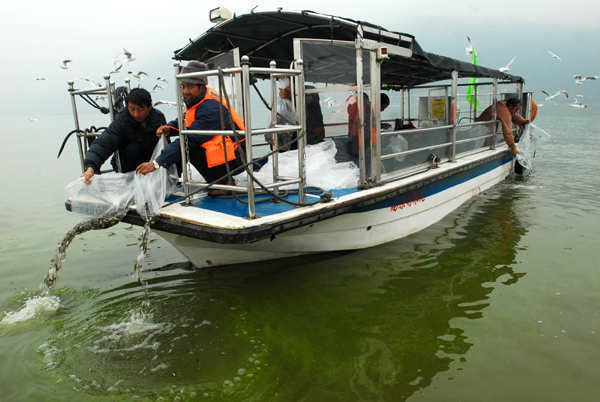
Fishermen release jinxianba, a species of ray-finned fish, into Dianchi Lake in Kunming, capital of Yunnan province, on Wednesday. Jinxianba, which curb the growth of blue algae, could help improve the water quality of the lake. [Ren Dong / China News Service] |
BEIJING - The expected rapid urbanization during the coming 12th Five-Year Plan (2011-2015) will threaten the security of China's water resources, authorities said.
Pollution control and prevention guidelines on eight major rivers and lakes across the country for the next five years were jointly released on Tuesday by the ministries of Environmental Protection, Water Resources, Agriculture, Housing and Urban-Rural Development, Industry and Information Technology, and the National Development and Reform Commission.
| ||||


The volume of pollutants in these waterways during the next five years will increase by 35 to 40 percent due to the industrialization and urbanization in the Haihe River area, according to the plan for that water system.
The plan for the Yellow River said rapid economic development along the river area would create a water shortage of about 14 billion cubic meters by 2030.
According to the plan for Liaohe River, which flows through Liaoning province, breakneck GDP growth will increase the pressure on the river system.
Water pollution has long been a problem for authorities.
At the end of 2007, about 9.5 million urban residents living along the Huaihe River faced the problem of unsafe drinking water, the plan said. The situation was worse in rural areas.
A four-year study released by the China Geological Survey in November showed that only 24 percent of the underground water in the North China Plain is safe for direct drinking as excessive heavy metal and chemical fertilizers were found in most water resources.
Ammonia and nitrogen tested in the eight rivers were highlighted on a black list of water pollutants, the plans said.
About 30 percent of the monitored spots along the Yangtze River were found to have excessive ammonia and nitrogen, mainly caused by domestic waste and excessive use of fertilizers.
In some parts of Huaihe River, the amounts of ammonia and nitrogen were more than 10 times the national standard for surface water, posing dangers to water safety. Industrial pollution and domestic waste accounted for 75 percent of these pollutants.
Li Shanzheng, professor with the Beijing Hydraulic Research Institute, told China Daily on Wednesday that water shortages in China were severe.
"Saving water and finding ways to recycle it will help to alleviate the pressure the country is facing," Li said, adding that the nation needs more sewage treatment plants.