Society
Study finds middle class 'unhappy'
By Wu Yiyao (China Daily)
Updated: 2010-12-08 08:24
 |
Large Medium Small |
 |
|
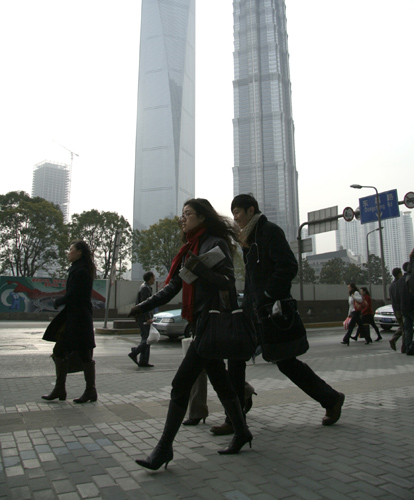
White-collar workers walk to work in Shanghai. [Provided to China Daily] |
SHANGHAI - Daniel Zhou (not his real given name) paused, trying to remember his son's age.
While it might seem shocking to some, his situation is far from unique among members of Shanghai's middle class, many of whom can not easily recall their children's birthdays or grades in school. They simply do not have time to spend with their families.
Zhou, a department director with a media company in Shanghai who asked his Chinese given name not be published, said he does not feel happy, even though he has a 300,000-yuan ($45,000) annual income, a well-decorated downtown apartment and a fancy car.
| ||||


"But we can't complain," he said. "At least we are better off than migrant workers."
Shanghai's middle-class families are the least happy, according to the White Book of Happiness of Middle Class Families released by Manulife-Sinochem early this year.
The white book was based on surveys of more than 100,000 people from 35 cities in 10 provinces and municipalities.
Even in the happiest provinces, such as Jiangsu, Sichuan and Fujian, more than half of middle class families said they are "not happy".
But Chinese Academy of Social Sciences' Social Policy Research Center Secretary General Tang Jun said the government should continue to strive to bring a third of the population into the middle class during the 12th Five-Year Plan (2011-2015) period. The middle class should become society's backbone and shoulder responsibility, he said.
About 23 percent of Chinese are middle class, and the proportion could increase to 40 percent by 2020, Chinese Academy of Social Sciences researcher Lu Xueyi said.
But Jessica Hu (not her real given name), a 33-year-old administrator of a foreign pharmaceutical company in Shanghai, said, "Middle-class families are often too weak to support themselves."
Hu said she often feels overwhelmed.
"I have to work very hard because I can't lose my job," she said.
"I need money to pay the mortgage, to give my son a better education and to support myself after retirement in a couple of decades."
Hu said most of the family's savings will go to her son's education.
The distribution of education resources is unfair, she said, but all she can do is to save enough money to pay for better schooling for her son.
The family also feels pressure from the increasing prices of almost all goods and services, she said.
"The only thing that hasn't gone up is our household income," Hu said.
"And we have to pay high taxes on almost everything - even birthday cakes."
The proposed 12th Five-Year Plan requires income growth to keep pace with economic growth. It also requires the fair allocation of public education resources, the expansion of social security coverage and the gradual removal of social security barriers.
"Government policies will certainly change people's feelings, but people need to adjust their mentalities, too," Daniel Zhou said.
"In the rat race that is keeping up with the Joneses, people forget about the most precious parts of life, such as spending time with families."
But it will take a long time, perhaps longer than five years, for an entire demographic to become more mature and sensible about making money and shouldering social responsibility, he said.
"People want to be both rich and responsible. But they crave money more than anything else, including responsibility, until they feel financially secure," Zhou said.