PHOTO |
 China
World
Newsmaker
Slides
Weekly Photos
Share Your Photos
Special China
World
Newsmaker
Slides
Weekly Photos
Share Your Photos
Special
|
|
 |
Large Medium Small |
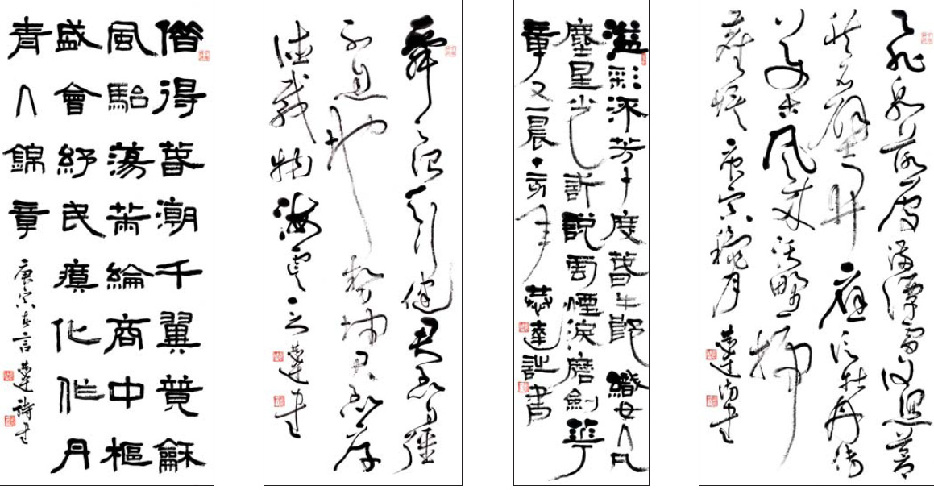
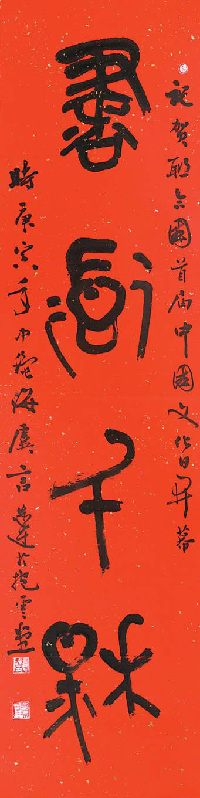
Work of contemporary calligrapher Yan Gongda goes on display at the UN
Editor's note: To celebrate the first Chinese Cultural Day held at the United Nations, the work of contemporary calligrapher Yan Gongda will be displayed on Nov 12.
|
 |
Because Chinese calligraphy is included in the culture day for the first time, Yan in turn is first of the nation's calligraphers to participate.
Yan Gongda is among the most influential artists in Chinese calligraphy today, renowned for his great freedom in brushwork, characters, ink and composition
The creator of two long scrolls for the Olympic Games and the Shanghai World Expo, now in professional collections, says "calligraphy showcases the insight and personalities of its writers - the freedom of the Taoists, the sympathy of Buddhists or the universal love of Confucians".
He said success in calligraphy is impossible without moral integrity - which he has advocated throughout his career through a respect for nature, a sympathy for people and a loyalty to the nation.
"He feels responsible for enhancing and developing Chinese traditional culture. Though calligraphy has an art for life," said art critic Shi Yanping.
Style and tools
Yan, who is also vice-president of the Chinese Calligraphers Association and professor at two universities, uses the calligrapher's tools of a brush made of long goat's hair and famed ink brand Yi De Ge.
He bases his calligraphy on rubbings, which he takes from stone and oracle bone inscriptions, and inscriptions on ancient bronzes and seals characteristic of the Zhou Dynasty (1045 BC-256 BC).
The artifacts have simple strokes that influenced Yan's own style, which is characterized by elegant, classic and compact lines.
He then integrates his own feelings in his work - "following one's own inclinations while observing the rules", as teachers of ancient calligraphy advised.
His work can be distinguished from the script of others by its flowing movement and powerful sense of momentum. He uses the "wrapped stroke" method in which lines twist and turn full of transformation and spirit.
Yan's work joins the extraordinary variety of calligraphic techniques, styles and compositions used down through time in China.
The calligraphic form was introduced during the Qin (221-206 BC) and Han (206BC-AD 220) dynasties. In the Eastern Jin Dynasty (317-420), Wang Xizhi, China's greatest master, perfected the cursive style.
During the Tang Dynasty (618-907), Zhang Xu broke with Wang's classical approach and developed a "wild" cursive style defined by emotion and spontaneity. Stories describe Zhang writing with his own hair, roaring drunk and shouting hysterically.
Today the structure used by Yan is dynamic, yet upright and decorous, elegant yet full of changes. From left to right the strokes linger, yet are separate in form.
"His ink technique is another highlight of Yan's calligraphy," said theoretician and critic Heng Zheng'an. "He uses several techniques to make the work vivid."
The last stroke of one character is the starting stroke of the next for Yan, resulting in a spirit that is unified through the characters as a whole. The approach not only preserves the fluency and magnificence of big cursive script, but also creates pauses and turns of rhythm - simple, yet magnificent.
Using a goat's hair brush and raw rice paper, the technique produces the effect of a single shade made from five layers of ink.
In his essay Discussion on Ink Technique, Yan elaborates on the techniques of the masters Sebi, Xiemo, Zhangmo, Sumo and Feibai.