Society
Land delivers crop of future security
By Hu Yinan (China Daily)
Updated: 2010-10-27 09:07
 |
Large Medium Small |
|
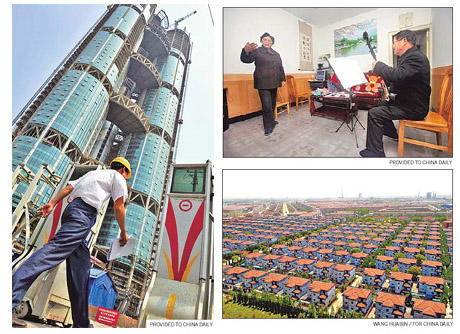 Clockwise from left: A construction worker passes the 74-story skyscraper now under construction in Huaxi; A couple in Tengtou practice singing opera at their home; A bird's eye view of Huaxi in Jiangsu province, reportedly China's richest village. [China Daily] |
No room to move
Tengtou's development is not without limits. As the number of local enterprises reaches 60, and with its eco-tourism industry expanding to include restaurants, motels and shops, the village economy in effect relies on more than 10,000 migrant workers who make on average 2,000 yuan a month and live in rental units costing up to 4,000 yuan a year.
"More than 90 percent of the laborforce here are (migrants)," said Lu Boqiang, deputy director of the village committee office, the de facto local government, who himself arrived from Fenghua, the county seat.
As a result, land has emerged as the top factor limiting Tengtou's development, a common problem for the 10,000 or so villages that have practiced collective economies and succeeded in making farmers self-sufficient through industrialization, elaborate accommodation and collective distribution of social welfare.
Tengtou is set to expand from its current 2 square kilometers to 11 sq km in the next two decades, but as China edges dangerously close to its "red line" of 1.8 billion mu (120 million hectares) of arable land - the least amount necessary to feed its 1.3 billion population - ever-stricter policies mean smaller, fixed land quotas for each layer of government.
This situation has made large-scale land acquisition, particularly by legally autonomous village committees at the most grassroots level, highly unlikely.
And even if proposals were approved, Fu Deming believes it would be "very improbable" for Tengtou to merge with other villages for political reasons.
"As far as (rural) elections go, people would have serious trust issues with candidates from other villages. It'd be completely chaotic," he said.
The state of Huaxi, China's richest and most well-known village, and one of the very few to have successfully lobbied for more land, offers a glimpse into some of Fu's worries in real life.
The village in Jiangsu province stood on just 0.96 sq km of land and was home to 1,520 people in 2001. Since then, it has been merged with 16 nearby villages, forming a de facto township of 30 sq km and home to 35,000 people.
Residents of the original Huaxi, each of whom were given villas and cars by the village collective for free, all hold sizable shares in the Shenzhen-listed Huaxi Group, so much so that 200 of the 380 families - 52.6 percent of the "base population" - have each invested 10 million yuan into completing their future homes in the world's 15th tallest building, a 74-story skyscraper that will be put to use next year.
Most of the 35,000 people in the greater Huaxi area are much less fortunate. Deprived of their farmland as a result of the merger, new Huaxi residents find themselves competing with migrant workers for jobs in nearby factories.
Meanwhile, residents who are too old for such jobs have no option but to stay home and wait for the pension and welfare they expected when they became "Huaxi folk".
For the time being, monthly packs of rice and flour are the only welfare residents of the greater Huaxi area receive.
"It's only been a couple of years," said Zhao Zhirong, Huaxi's deputy Party chief, stressing that the principle of fairness must be upheld. "People in the central village worked for decades to get to where they are now. These things take time."