Economy
Consumer price increase sparks worries
By Xin Zhiming and Wang Xiaotian (China Daily)
Updated: 2010-10-22 06:31
 |
Large Medium Small |
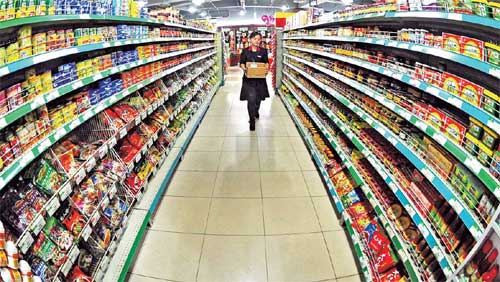 A supermarket employee packs shelves in Yinchuan, capital of the Ningxia Hui autonomous region, on Thursday, Oct 21, 2010. The National Bureau of Statistics said that China’s economy grew at a slower but still robust pace of 9.6 percent in the third quarter, and the consumer price index rose 3.6 percent in September from a year earlier, the fastest pace since October 2008. [Photo/Xinhua] |
BEIJING - China still faces strong inflationary pressure in the coming months after consumer prices hit a nearly two-year high in September, raising the possibility of more monetary tightening measures, economists said.
The possible measures, however, will not hamper China from playing a major role in the global economic recovery, they said.
China's gross domestic product (GDP) registered 9.6 percent growth year-on-year in the third quarter, slowing down from 11.9 percent in the first quarter and 10.3 percent in the second, the National Bureau of Statistics (NBS) said on Thursday.
| ||||


Price rises contributed to 64 percent of the CPI increase, compared to 36 percent from the comparison base last year, said NBS spokesman Sheng Laiyun at a State Council Information Office news briefing.
Higher imported inflation risks caused by rising commodity prices, and increasing labor and raw material costs would continue to drive up the index for the rest of the year, he said.
But last year's higher comparison base, a new grain harvest this year, and an oversupply of industrial goods would help cool inflationary pressures.
Many analysts predict the figure will rise slightly before declining gradually by the end of the year.
The index might reach 4 percent in October and start to decline in November, Lu Zhengwei, chief economist at the Industrial Bank, said.
Matthew Circosta, economist at Moody's Analytics in Sydney, said food prices would continue to be the main cause of inflation. "Higher food prices will indirectly add to production costs and raise inflation expectations," he said.
Wang Tao, head of China Economic Research at UBS Securities, also said the CPI will likely peak in October at about 4 percent.
Given that China has set a target of keeping inflation below 3 percent for this year, more monetary tightening could come, analysts said.
"In the near term, we expect the government to gradually hike (interest) rates without hurting the growth momentum", said a Citigroup report, while pointing to the country's solid GDP growth in the third quarter.
NBS spokesman Sheng said although price increase pressures remained, it was still "possible" to achieve the 3 percent target.
The central bank raised the interest rate for the first time in almost three years on Wednesday to combat inflation and soak up excessive market liquidity.
In remarks that may provide some insight into the reasons that led the central bank to the hike interest rate, central bank governor Zhou Xiaochuan drew attention to a series of potential pitfalls.
"Macro-economic risks linked to excessive liquidity, inflation, asset bubbles and a cyclical rise in bad bank loans are rising significantly," he said in comments published on Thursday.
He made the remarks at a meeting between the International Monetary Fund and central bankers in Shanghai early this week.
"There is still relatively strong momentum for domestic credit to keep expanding," Zhou said.
Zhou added that the "asset quality and risk-resisting capabilities of the financial industry will face serious tests".
There was a mixed response to the rate hike in global markets with some dropping on concerns that monetary tightening in the world's second largest economy could lead to slower growth, which could affect global recovery.
But the third-quarter GDP data should alleviate such concerns, economists said.
"The data sent a very optimistic signal to the rest of the world that China would secure a GDP growth rate of nearly 10 percent this year," Zhuang Jian, senior economist at Asian Development Bank in China, said.
"We do look for further (interest rate) hikes at some point, if domestic asset prices continue to rise," said Li Wei, an economist with the Standard Chartered Bank. "We still forecast two hikes in the first half of 2011."
Government's measures to cool the housing market as well as the closing of outdated industrial capacity slowed growth, said Zhu Baoliang, a researcher with the State Information Center.
But "the economic performance is generally sound," NBS spokesman Sheng said.
Reuters and AFP contributed to this story.