Economy
China to reduce rare earth export quotas
(China Daily)
Updated: 2010-10-19 07:05
 |
Large Medium Small |
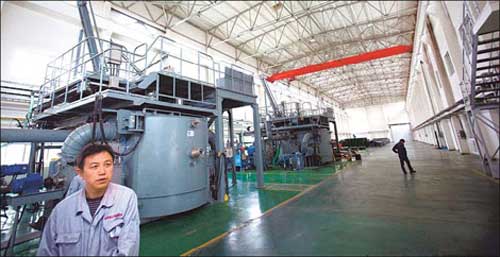 Technicians work at the production facility of Inner Mongolia Baotou Steel Rare-Earth Hi-Tech Co in Baotou, Inner Mongolia autonomous region. Chinese officials said the country's rare earth reserves will last for 15 to 20 years.?[Photo/Agencies]? |
Beijing - China will further reduce quotas for rare earth exports by 30 percent at most next year to protect the precious metals from over-exploitation, said an official from the Ministry of Commerce.
He added that the country is now facing the possibility that reserves of medium and heavy rare earths might run dry within 15 to 20 years if the current rate of production is maintained.
Export quotas will continue to be axed in the first half of next year, said the source who declined to be named.


Rare earths, composed of 17 elements, are used in a number of high-tech processes ranging from wind turbines and hybrid cars to missiles.
Domestic deposits dropped to 27 million tons by the end of 2009 - that's 30 percent of the world's total explored reserves - from 43 million in 1996, said Chao Ning, section chief of foreign trade with the ministry at a Beijing conference.
He said reserves of medium and heavy rare earths may only last 15 to 20 years at the current rate of production, which could lead to China being forced to imports supplies.
Medium and heavy rare earth, also known as ion-absor bed-type rare earth, is more valuable than the lighter variety. It's used in advanced areas such as missiles.
China's verified reserves of ion-absorbed-type rare earth stood at 8 million tons in 2008, while reserves of light rare earth totaled 50 to 60 million, according to data from the Ministry of Land and Resources.
"China is not the only country that has these deposits, but it has been dominating the world's supply market for more than a decade, thereby depleting its own resources," Chao said.
He added that strategic, environmental and economic considerations mean that the country can't afford to continue shouldering the burden of supplying the world.
Some developed countries - such as the United States, which alone holds 15 percent of the world's reserves - depend almost entirely on Chinese supplies. They ceased domestic production long ago because importation is more cost effective.
Prices in China rose by fractionally more than 20 percent since 1979 to hit an average of $8,500 per ton in 2009.
Prices started to pick up in the middle of that year as the government began to reform the industry by cracking down on illegal mining practices and by reducing exports.
Some of the major rare earth oxides, such as neodymium, had rallied to 24,600 yuan a ton by the end of September, a rise of 80 percent from January.