Foreign and Military Affairs
Premier Wen will not meet Japan PM
By Bao Daozu (Xinhua)
Updated: 2010-09-22 07:29
 |
Large Medium Small |
'Atmosphere not suitable' as relations sour over captain's illegal detention
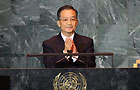
BEIJING - Premier Wen Jiabao will not meet his Japanese counterpart during an upcoming UN summit in New York because the atmosphere is "obviously not suitable", Foreign Ministry spokeswoman Jiang Yu said on Tuesday.
"Given the current atmosphere, arranging a meeting clearly would be inappropriate," she said.
| ||||


Bilateral relations have been severely damaged, she said during a regular news briefing. "The key to solving this problem is in Japan's hands," Jiang added.
She urged Japan to better grasp the situation, and take pragmatic steps by allowing the captain to return home immediately without any conditions.
China has taken a series of countermeasures against Japan including halting ministerial-level exchanges and meetings in other areas, after a Japanese court announced a 10-day extension to the illegal detention of the Chinese captain.
On the cultural front, an invitation to about 1,000 Japanese youths to the World Expo in Shanghai has been canceled and ticket sales have been suspended for concerts at the Expo site next month by Japanese pop band, SMAP.
Tourism in Japan has also been affected due to a sharp decline in the number of Chinese citizens traveling there in an expression of outrage toward the country. Many of the trips were canceled at the last minute.
"Chinese citizens would definitely choose to travel to a place both secure and delightful," Jiang said, in response to a question on whether trip cancellations were on a voluntary basis.
On the Japanese side, Tokyo's governor Shintaro Ishihara said on Tuesday he would scrap a visit to Beijing, AFP reported.
The flare-up started with the Sept 7 interception of a Chinese fishing trawler by Japanese coast guard vessels near the Diaoyu Islands, followed by Japan's illegal detention of the boat's captain. A Japanese court accused him of "obstructing officers on duty", citing domestic law.
Fourteen members of the trawler's crew returned home on Sept 13 and the boat was brought back. Yet Japan has ignored China's repeated demands for the immediate and unconditional release of captain Zhan Qixiong.
The relationship between the two countries has spiraled downward. On six occasions Beijing summoned the Japanese Ambassador to China, Uichiro Niwa, to lodge strong protests at Japan's actions.
Japan on Tuesday called for the eradication of "narrow-minded and extreme nationalism" in both countries, according to Kyodo News Agency.
"For the peace and development of East Asia and the Asia-Pacific, we want to use all available means of communication to ask that this be resolved without the situation escalating," Japanese Chief Cabinet Secretary Yoshito Sengoku told a news conference.
Analysts believe that Japan's moves have unveiled its real intentions.
"Japanese media reports have mainly focused on the protests from China but have ignored the fact that it was Japan that caused the problem. So the Japanese people are not familiar with the cause of the event," said Feng Zhaokui, former deputy chief of the Institute of Japan Studies at the Chinese Academy of Social Sciences.
"It is quite normal that Chinese citizens express anger toward Japan, because the Diaoyu Islands are, without doubt, an integral part of Chinese territory. Japan's calling to avoid so-called nationalism, in essence, reflects Japan's own nationalism," Feng told China Daily.
"The current cabinet under Naoto Kan's leadership is more hostile toward China, in which the hawkish Maehara Seiji, Japanese foreign minister and former transport minister, plays a very important role," Feng said.
Analysts also agree that it is up to Japan to decide the future of the relationship.
"Ahead lie two scenarios. One is further deterioration of the relationship, turning from one of mutual benefit to one of strategic contention. The other is based on long-term interests," said Liu Jiangyong, a senior scholar of Japan studies at Tsinghua University, when interviewed by Singapore-based zaobao.com.
"How to avoid the escalation of tensions and properly settle the dispute has now become crucial," he said.
It could be the importance of economic ties that brings Japan to its senses, Feng said.
"China and Japan are highly interdependent especially in trade. Every Japanese person is benefiting from the intertwined economic ties. When Japan's miscalculation genuinely hurts the interests of its own citizens, Tokyo will consider a retreat on this issue," Feng predicted.
He Wei, Zhou Wa and AFP contributed to this story.