Society
Coal ashes toxic problem: Greenpeace
By Jin Zhu (China Daily)
Updated: 2010-09-16 07:51
 |
Large Medium Small |
|
 |
|
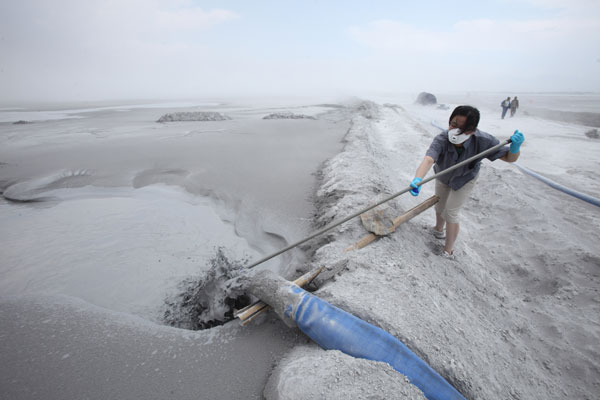
Ash chokes the sky above a coal ash dam owned by the Shentou No 2 Power Plant in Shuimotou village, Shuozhou, Shanxi province, in this file photo taken in June. [Zhao Gang / Greenpeace] |
BEIJING - China's coal-fired plants produce enough toxic ash to fill an Olympic-sized swimming pool every two and a half minutes, creating contaminants that travel far and wide, Greenpeace said on Wednesday.
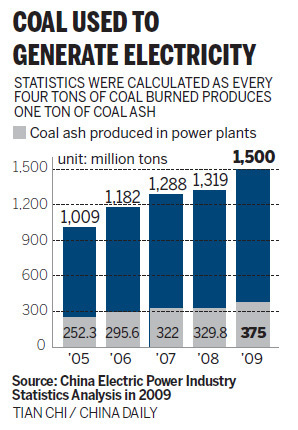
As the world's largest coal user, China's more than 1,400 coal-fired electrical plants produce at least 375 million tons of coal ash every year - 2.5 times the quantity in 2002, the environmental group said.
That means coal ash has become China's largest single source of industrial solid waste, as the country depends on coal-fired power for 70 percent of its energy.
"Every four tons of burned coal produces one ton of coal ash," Yang Ailun, a climate campaigner at Greenpeace China, said at the launch of a report on the cost of coal in the Asian nation.
"This substantially erodes China's already-scarce land and water resources, while damaging public health and the environment," she said.
In 2009, China consumed more than three billion tons of coal, more than half of which was used to generate electricity, official figures show.
Many power plants did not follow regulations on coal ash disposal, the report said. Greenpeace investigated 14 plants around the country and found many disposal sites were located too close to villages and residential areas.
According to the country's standards for pollution control, coal ash disposal sites should be at least 500 meters away from the nearest residential area.
However, most ash disposal sites are much closer to the nearest village.
"This affects nearby villages most directly, but it also poses huge threats to all of China, as contaminants enter the food chain or are scattered by the winds far and wide."
According to the report, coal ash can spread over an area spanning up to 150,000 sq km - the size of Nepal - in high winds.
Greenpeace reported it had collected samples from the plants' disposal sites. The samples contained more than 20 different kinds of harmful substances, including lead, mercury and arsenic.
"Many of the coal ash disposal sites we visited had poor safeguards to prevent coal ash contamination via wind dispersal or leakage into water," Yang said.
The report indicated China's coal power industry produces a total of 25,000 tons of heavy metals, including cadmium, chromium, arsenic, mercury, and lead every year. Also, surface water and underground water had been severely polluted, the report said.
In Douhe Power Plant, Hebei province, for example, surface water had traces of fluorides 233 percent higher than the concentration allowed by the country's environmental quality standards. Also, the concentration of nitrates in its underground water was 36 percent higher than sanitary standards for drinking water.
The harmful substances have been detected in milk cows, the report said, adding the government needs to strengthen regulations and oversight on coal ash disposal, storage and recycling.


"Currently, only fines are imposed for illegal practices at ash disposal sites. However, the fines are not powerful enough in the long term," Yang said.
Huang Shengchu, head of China Coal Information Institute, said China now is speeding up its progress in coal ash recycling, which is expected to reach 75 percent by 2010.
"Coal ash can be recycled as building materials, such as bricks or used to surface roads. Also, new techniques are being widely used that reduce coal ash when coal is burned in power stations," he said.
AFP contributed to this story.